| x | |||||||||||||||||||||||||||
 |
Madme Ching | ||||||||||||||||||||||||||
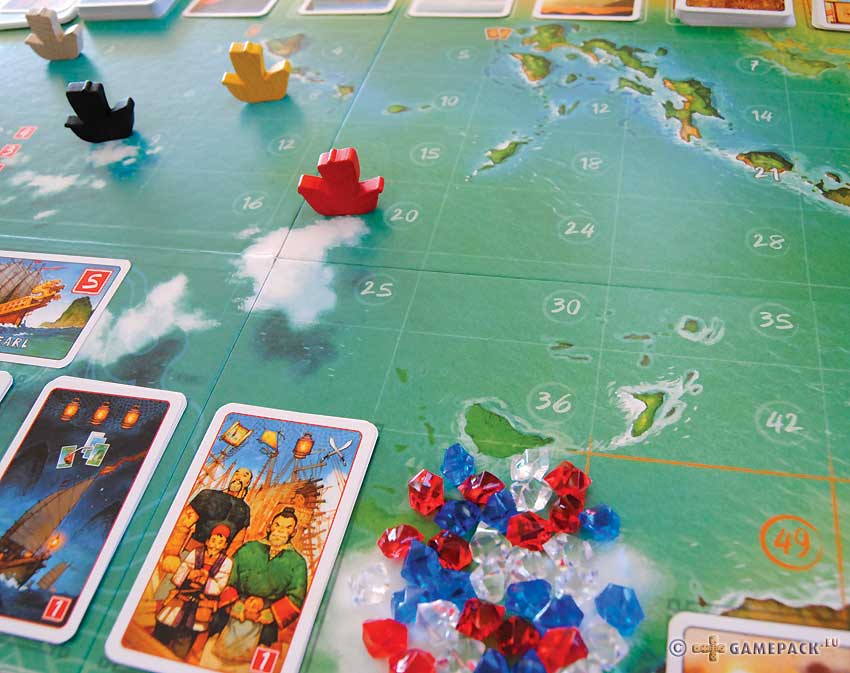
| 06.10.15 Why did the editor even bother making up a cock and bull story about the illustrious pirate Madame Ching allegedly was? We’re merely playing our navigation cards and move our ships accordingly across the board. Every card has to be of higher value than the previous card. If the colour of the card is identical to the previous card, the ship moves forward; if the colour is different, the ship moves diagonally, thus covering a wider distance. The fields are numbered; these numbers come into play when finishing an expedition. An expedition is finished when the player can’t (or doesn’t want to) add a card of a higher value, and instead plays a card of a lower value. The player then takes a mission tile of a value identical to the value of the sea space where the mission ended. The higher the number, the better the mission tile. The tiles depict gems of different colours, representing different values, and sometimes also encounter cards. Encounter cards allow the player to for example steal a gem from another player, score additional points at the end of the game, or to move diagonally even if a navigation card of the same colour was played. Many navigation cards also show a symbol: a kite, a lamp, a map or a sword. If a player’s expedition contains three identical symbols, or all four different symbols, he is allowed to draw a skill card. Skill cards also give one-time bonuses, like adding 6 to the number on the sea space where he ended his expedition, thus allowing him to collect a much more valuable mission tile. Each game of Madame Ching seems to follo the exact same path: first, the players want to travel as far as possible to collect the most profitable mission tiles. But later, when these mission tiles are exhausted and there is no need to travel very far, the lower mission tiles are ‘swept up’ until the last one is gone. Then, the gems are converted into victory points, and the player with the highest score wins the game. The game also ends as soon as one player has collected all four skill cards. As a reward, he gets control of the flagship China Pearl, which scores 5 points. But the game is too short to collect many skill cards; it’s already hard enough to collect three identical symbols in your expedition, since the choice which card to play is governed by other factors than just those symbols. There is another card on the board that can be reached by boat: it’s the city of Hong Kong, which is worth 10 victory points. But this could have been left out just as well: to be able to reach the card, a player needs to play all five different colours of navigation cards, plus some encounter cards that allow him to travel diagonally when playing the same colour: there simply aren’t enough colours in the game to reach Hong Kong otherwise. Trying to get all these conditions just right will take a player the entire game. All-in all, Madame Ching is a disappointing experience; players play cards form their hand, and refill their hand from a display that contains a number of cards equal to the number of players. Moreover, one of these cards is face-down. And how much fun is it that other players can steal one of your hard-earned gems using an encounter card? No, the pirate Madame Ching may have her charms, but the game fails to captivate us. Madame Ching, Bruno Cathala & Ludovic Maublanc, Hurrican/Asmodee, 2014, 2 to 4 players, 8 years and up, 30-45 minutesxxtop  |
 |
||||||||||||||||||||||||||
| x | |||||||||||||||||||||||||||
 |
Mangrovia | 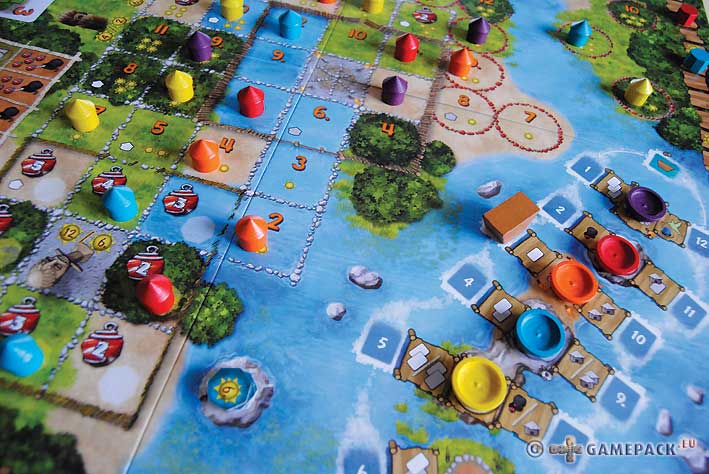 |
|||||||||||||||||||||||||
| 18.09.15 The old Chief of an ancient tribe in the jungle is dying. The tribe needs to find a successor! A successor who can maintain the delicate balance between man and nature, who respects the ancient customs of the tribe, and who honours the Ancestral Spirits. The players of Mangrovia take up this challenge! They build huts and collect amulets in order to please the Ancestral Spirits and gain favour within their tribe. The most influential candidate will become the next Chief! The board depicts a grid composed of four different landscape types. Each round, players may build on only two of those types. Building huts is performed by playing the appropriate landscape card, accompanied by a sum of ‘money’ (pineapples, feathers, shiny stones, et cetera). Sometimes a pay in amulets is demanded. With the amulets as well as the ‘valuables’, you have to pay the exact amount! The player subsequently places his hut on the board, and scores points if applicable (sun). At the end of the game, points are awarded for the majority of huts in each row and column of the grid. That sounds rather straightforward; but wait, there’s more! There is an archipelago consisting of small islands where actions can be performed. In player order, the players place a bowl in their player’s colour on the action field they wish to perform. Then, a ship sails around the archipelago. First the actions on the left side are carried out, and then the actions on the right side. So, each location is good for two actions. The options are: draw open or face-down cards (landscape/valuables); build huts; draw amulets from the bag. At the beginning of the game, a player is not allowed to draw amulets from the bag, but he has to take a value ‘1’ (the absolute minimum) amulet from the stack. Only after building huts at specific locations on the board, he is allowed to draw more and more amulets from the bag. The value of the amulets is not to be underestimated: not only are they used as building material during the game: they also score points at the end of the game. The ultimate goal of Mangrovia, obtaining majorities of huts in the columns and rows, is not a very innovative concept. The fun of the game is introduced by the archipelago. The ship sails around the islands, meaning that the players who were early on the way down, will be late in turn order on the way up, in accordance with the biblical concept of ‘the last will be first, and the first last’. This results in interesting deliberations. The left-side actions involve drawing cards, and the right-side actions involve building huts. The early card-drawers have first choice from the face-up displays, but are last in actually building their huts. And that means that their intended building location might very well have been occupied by an opponent by that time… But the later card-drawers risk that they can’t get their hands on the cards they need to build their huts. Don’t forget that you have to pay the exact right amount, and that you can only build on two landscape types each round! Mangrovia is a simple game with a low threshold, but its intricate and well-balanced turn order mechanism lifts it well above the competition. Barbara van Vugt Mangrovia, Eilif Svensson, Zoch, 2014 –-2 to 5 players, 10 years and up, 60-90 minutesxxtop |
|||||||||||||||||||||||||||
| x | |||||||||||||||||||||||||||
|
Mauna Kea | ||||||||||||||||||||||||||
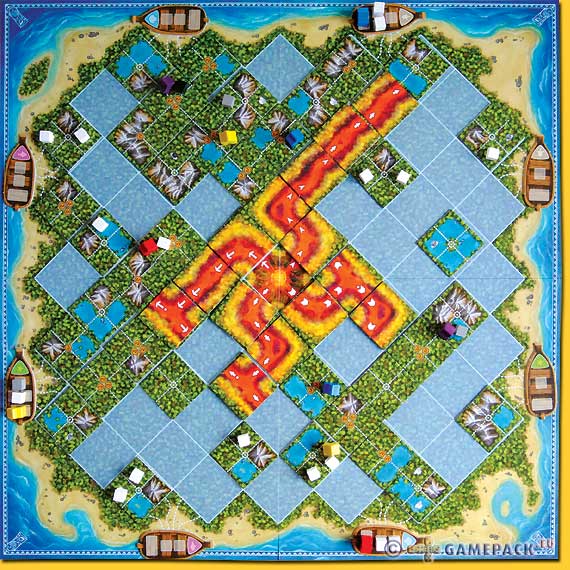
| 01.06.14 Four research teams are exploring the Pacific island Mauna Kea. This is not without risk: Mauna Kea harbours a slumbering volcano! Rumble rumble - Oops: did we say ‘slumbering’? RUN FOR YOUR LIFE!!! Four streams of lava emerge from the centre of the board. Players have to lead their researchers to safety: the island is surrounded with boats, and the first researcher to reach a boat immediately takes off! Of course we try to rescue as many artefacts as possible on the go. All players have a number of tiles open in front of them, depicting a landscape as well as 1-3 feet symbols. On his turn, a player has to use all his tiles. For each tile he can decide to either place it on the board in order to establish a route to a boat or an artefact, or alternatively, to use the feet-symbols to move his researchers. Entering jungle takes 1 foot, entering water 2 feet, and mountains cannot be entered. Each researcher can carry as much as three artefacts on his journey. At the end of his turn the player draws tiles from the bag until he has at least 5 feet symbols. If a lava tile is drawn, it has to be placed on the board immediately. Each of the four streams has its own arrow-symbol, and the new lava tile has to be connected to its corresponding stream. Areas covered with lava tiles can no longer be crossed or entered! If a researcher is caught in the lava, he is permanently doomed and removed from the game, together with any artefacts he might have been carrying. The researchers that do manage to reach a boat can load it with up to 3 artefacts, depending on its size. The game is over as soon as one player has no more researchers on the island, either because they are safely on board, or because they have all perished. Every researcher that has been saved yields three points, and the artefacts score 1 to 3 points depending on their colour. Researchers who have entered a large boat empty-handed will be punished: for each vacant position in the boat one point is subtracted. Mauna Kea is a very random game, but it is fun and short enough to accept this shortcoming. One characteristic of the game that will appeal to many: there is ample opportunity to block other player’s researchers by surrounding them with hard-to-cross landscape tiles. As a consequence they will have to take a detour and they might not be able to get out of the Ground Zero area in time; it happens occasionally that a player loses all his (3-5) researchers! There is an expert version with cards that grant players special abilities they can use to save their souls, like unlimited movement through one terrain type, rotating or replacing a landscape tile to free themselves, or even a helicopter to rescue one researcher from anywhere on the board. Players are allowed to select their own cards at the start of the game; since these cards add strategic options and eliminate some of the randomness of the game, this expert version is definitely recommended for experienced players. Barbara van Vugt Mauna Kea, Touko Tahkokallio, Huch! & Friends, 2013 - 2 to 4 players, 10 years and up, 45 minutes.xxtop |
 |
||||||||||||||||||||||||||
| x | |||||||||||||||||||||||||||
|
Keyflower - The Farmers | ||||||||||||||||||||||||||
|
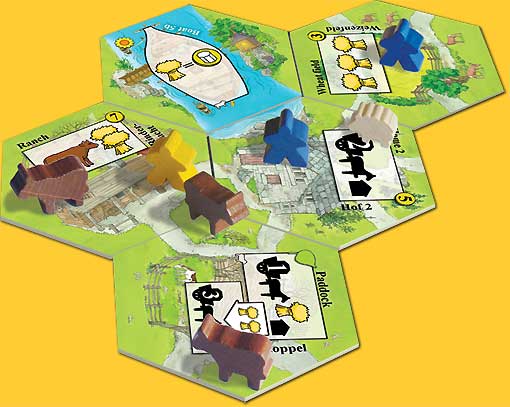
12.10.14 In this Keyflower expansion, the players are developing their agricultural skills. In addition to the standard Keyflower resources, wheat, sheep, pigs and cows can be produced. The expansion contains the required animeeples, plus season tiles for each season, which mostly have something to do with production or scoring of animals. The animals are placed on a field on the tile that enabled their production. Pay close attention to all the roads, fences, walls, streams and more of the sort to be able to distinguish what parts of a tile do or do not belong to the same field! Every two animals in the same field reproduce at the end of each season, except for the winter. But, at the end of the game, points are scored for each field containing at least one animal, and there are no extra points for any additional animals present! So, toward the end of the game, the animals have to be moved to different fields to be able to yield points. They can be transported using the transportation action that is also used for standard resources. Wheat tokens can be used for additional steps. According to the rules, The Farmers expansion can be either shuffled in with the standard game, or it can be used as a whole and just supplemented with season tiles from the standard game when necessary. Neither option is perfect: when the tiles are shuffled in with the standard game, chances are that for example the tile to score additional bonus points for sheep does enter the game, but no tiles to actually produce sheep are drawn. When The Farmers is used as a whole, and just supplemented with tiles from the standard game, another problem arises: there are hardly any tiles present to produce the standard resources, while these resources are required for certain productions, for bonuses, and for the improvement of many tiles! This is especially a problem with two players, since only two tiles from the standard game are added each season. In both configurations it feels like playing two different games simultaneously. A general complaint with expansions is that they don’t add enough extra’s to the game; in this case the problem is that the expansion is a completely different game! In addition to the incompatibility of the standard game and the expansion, The Farmers has another disadvantage: the drawings on the season tiles were originally only meant as decoration. But now it is suddenly important to be able to distinguish where one field ends and another one begins. The animeeples are so big, and the illustrations so tiny, that two sheep can completely cover one small field plus surrounding roads, making it very hard to see which animals are in the same field. Also, the mere presence of the animals all over the tiles often obscures their function, both for their owner and for other players, who are also allowed to place their workers on those tiles! Altogether The Farmers involves too much hassle on the season tiles, and as a consequence the elegant simplicity of the standard game is severely compromised. Barbara van Vugt |
 |
||||||||||||||||||||||||||
| x | |||||||||||||||||||||||||||
|
Love Letter | ||||||||||||||||||||||||||
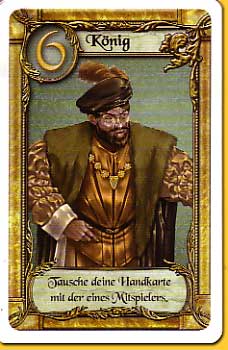
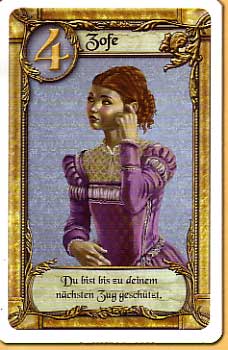
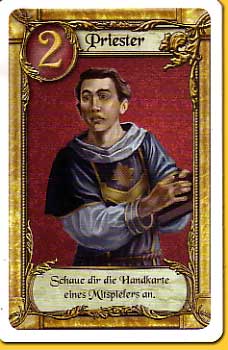
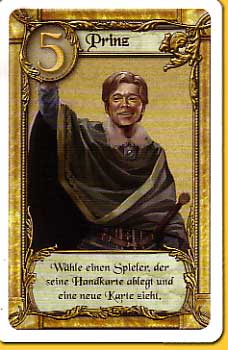
| 02.01.14 In recent years small Japanese publishers come to Essen under the umbrella of 'Japon Brand' to sell their goods and/or attract the attention of the big game publishers. It may be called a bit of a stereotype that almost without exception these games are physically very small, as if made to fit in your breast pocket. 'Love Letter' can be considered the most successful of these games: with its only 16 cards and a handful of markers it could be the winner in 'design a small game' contest. The rules are also not very extensive: the 16 cards come in 8 different types/characters, each with its own function. The Love Letter theme is so minimal that we don’t even bother to describe it. The game is played over a number of rounds. Each round each player is dealt one card and in his turn he draws a second one, after which he plays one of the cards, applying its function. An example of such a function is guessing another player’s card/character . When correct that player is out of the round; or just looking at a player’s hand/one card, thereby hoping he can be played out of the round in a future turn. Winner of a round is the player who is the last player left or who has the highest card after the pile of cards has run out. A round can take about 5 to 10 minutes, depending on the number of players and the course of play. The winner of the round gets a marker, and with a certain number of markers one is the winner of the game. 'Lover Letter' joins with its original and simple approach towards card guessing and bluffing a list of 'fillers'; a list that is nowadays under continuous scrutiny, so this may be called a great accomplishment for such a 'Bonsai' formatted game. Small? Not quite: in the German Pegasus Spiele version the cards are quite large and made of thick cardboard and it comes with nice wooden hearts as markers. As such we cannot refer to this as 'Bonsai-gaming' anymore, but anyway, it increases the pleasure of playing 'Love Letter' a lot! Edwin van de Sluis Lopve Letter, Seiji Kanai, Pegasus Spiele, 2013 - 2 to 4 players, 10 years and up, 20-30 minutesxxtop |
    |
||||||||||||||||||||||||||
| x | 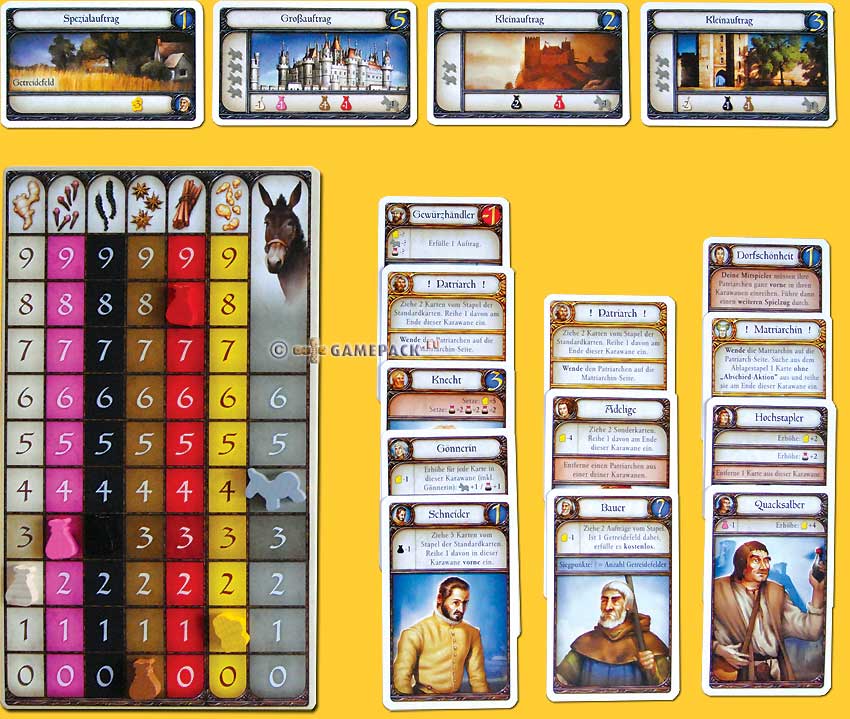 |
||||||||||||||||||||||||||
|
Kashgar | ||||||||||||||||||||||||||
|
15.11.13 During or after ‘Spiel’ in Essen many wonder: what was the trend? In fact this is a silly thought, because there never is a conscious trend; publishers do not en masse prepare for a new season by saying: ‘This autumn everything will be pink’. Besides, they are dependent from the - varied - offerings by authors and only in a single case can minimally adjust a game by changing the theme, for instance. No, at the very most there are a few striking yet accidental similarities. One of it could be that this year quite a few card games have been published that were boxed in an oversized box that normally holds board games, the cards being accompanied with some excuse parts to justify the large box. |
|||||||||||||||||||||||||||
| x | |||||||||||||||||||||||||||
|
Kemet | ||||||||||||||||||||||||||
|
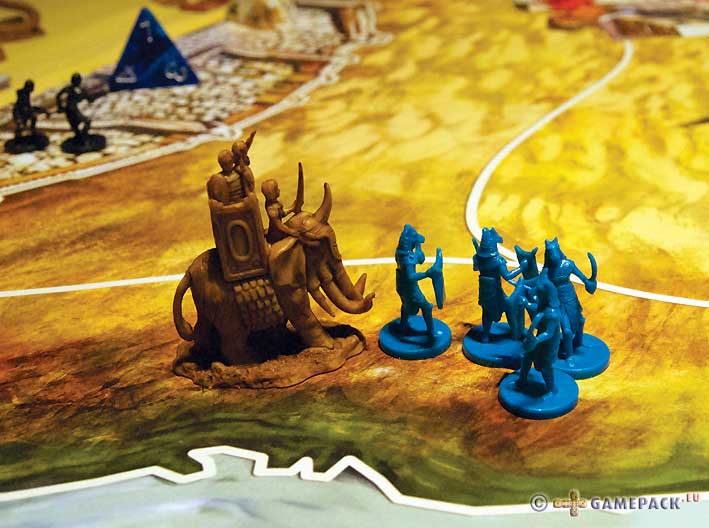
22.03.13 On a board depicting the Nile delta two to five players battle for points, eight or ten. These points can be earned by a succesfull attack on another player, controlling temples or upgrade a piramid to level four. In the night phase players receive prayer points, and cards are dealt that can be played during a battle. During the day phase one by one players take an action on their player board; they buy armies, upgrade piramids, move armies, collect prayer points or additional equipment aiding a player in an attack, defence, in movement, or it supplies resources. These extras, tiles, come in strength one to four, and have a relation with the strength of the piramids as a player only may buy tiles in a colour up to the strength of the corresponding piramid. The tiles give a player a modifier on the die in an attack, in defense or it gives additional movement. Then there are the monsters, animals, mythical beings, or whatever they are called. These come with certain tiles and their function is no different than a tile, being a modifier that is, but they look nice on the board and probably that is why they were inserted. |
 |
||||||||||||||||||||||||||
| x | |||||||||||||||||||||||||||
|
Libertalia | ||||||||||||||||||||||||||
|
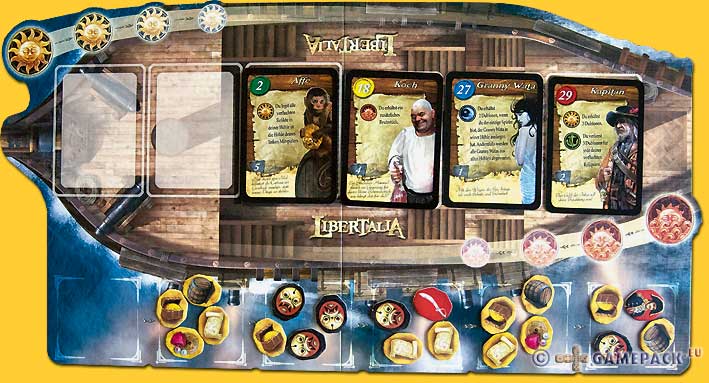
13.01.13 Two to six pirates play three robbery campaigns of three weeks, after which the player with the most points may set course to libertalia, say the Mallorca for retired pirates. Each day the players play a character card from their hand of nine different but for each player initial identical set of cards. The pirate ship is filled with the accumulated treasures the pirates have shopped together, as many as participating players, some of them valuable, others a bit mwah, and one or two outright to be avoided because it’s a curse. Superstitious people as they are, pirates rather don’t want these curses in their pocket. |
 |
||||||||||||||||||||||||||
| x | |||||||||||||||||||||||||||
|
Medieval Mastery | ||||||||||||||||||||||||||
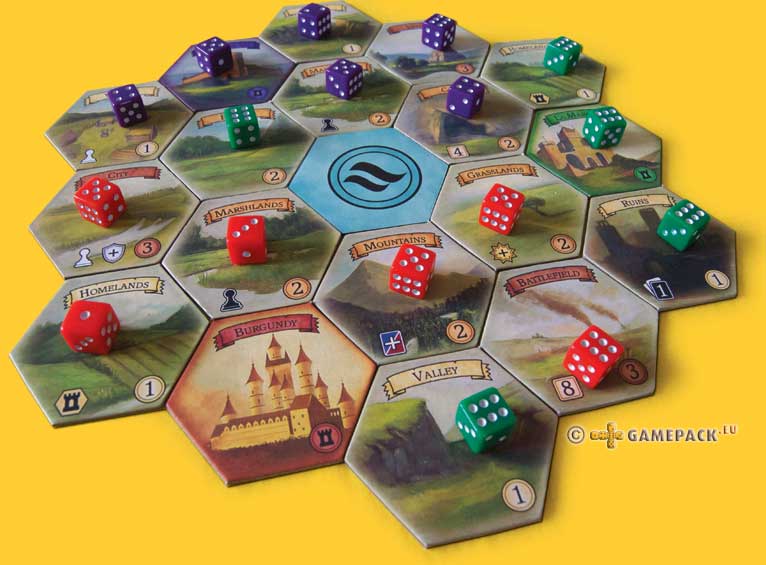
| 21.11.12 A box full of dice! No less than 60 in six different colours! As provincial lords in feudal France in the Middle Ages, we attempt to conquer surrounding lands in a struggle to claim the throne, or, in more abstract terms, 13 victory points. Those who are looking forward to heavy-duty dice throwing will be disappointed: the dice are unusually static in this game. They merely serve as markers to indicate how many knights are stationed in a certain territory. The board consists of hexagonal territory tiles each worth 1 to 3 points. The players have their own castle where new knights assemble every round. From there, they roam the surroundings to conquer adjacent territories. If a player enters an empty territory, he simply transfers some of his knights from his castle to the new territory. But, if a territory is already owned by another player, he has to fight for it. And not with dice, but with cards. Players each have three artefact cards with special features that can be used every turn, and a personal deck of cards. In case of a fight the defender and attacker both draw cards until they have five. The number of knights used for the attack indicates the attacker's strength, while the strength of the defender is determined by the number of knights currently residing in the territory under attack. Cards can be played by both sides to increase the fighting strength. The player with the highest total wins the fight and gets control of the territory. The surviving knights of the losing player retreat to his castle. And this continues until a player has collected 13 victory points. This can take a while: whenever a player gets close to the goal, the other players are bound to collectively attack him. But since the consequences of a lost battle are not very harsh, he will soon recover and report back in the battlefields. Therefore, the game tends to drag, and it becomes a bit tedious and repetitive. The artefact cards add some excitement to the game. Unfortunately, these cards range from rather useless to extremely strong, and there are also some very good or rather poor combinations possible. This can result in very unequal chances for the different players. Since players have the opportunity to completely regroup their knights every turn, the board changes constantly and there is no such thing as a strategic location or a well- or ill-defended area. This makes it impossible to develop a strategy, or any plan whatsoever. All things considered, Medieval Mastery is a rather random and repetitive game. Barbara van Vugt Medieval Mastery, Miles Ratcliffe, Chaos Publishing, 2012 - 2 to 6 players, 10 years and up, 30-60 minutesxxtop 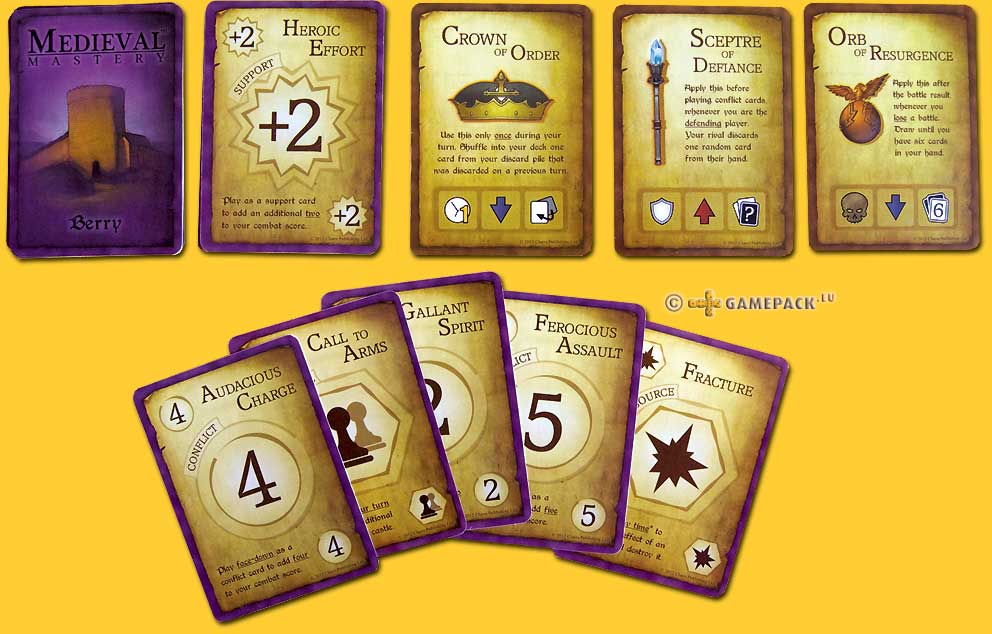 |
 |
||||||||||||||||||||||||||
| x | |||||||||||||||||||||||||||
|
Milestones | ||||||||||||||||||||||||||
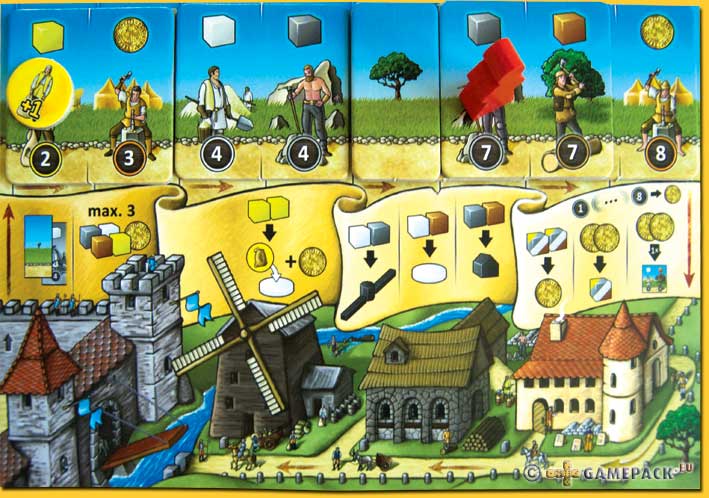
| 25.08.12 In front of us we find a landscape with milestones of different values, and further various bonus chits that are placed randomly but at determined spaces. By building roads, houses and markets and offer grain to the market, points can be earned. When building adjacent to a bonus chit, it may be taken and placed at the player board at the worker concerned. At the start of the game, each player has chosen two tiles of two workers each, so in total has four workers; there is space for a maximum of eight workers that can be hired and work on the land to earn grain, stone wood, sand and curiously enough money too. After this labour players head for town with its trade office, construction office, mill and castle, adfter which a cycle is completed and the whole shebang is repeated again. A player token indicates the position on the player board; it may be moved an undefinate space up to two times a turn but must stop at the castle for a supply check: no more than three items, resources and/or money may be taken into another round. A player may take the resource of the worker where its token ended its move, plus all other same resources that were skipped during this move. With the acquired money new workers can be hired from a window of five tiles; rich players even can exchange money into resources, or exchange resources into money; all this to be executed in random order. At the construction office the saved resources are exchanged for streets, markets or houses that are placed on the central board and earn a player points. The mill offers additional points for players who manage to deliver grain to a market. The castle has another not unimportant element: each time a player stops here - and he has to stop at the castle, no choice here - he has to send a worker home by covering the tile (partially), free choice. It is therefore important to have enough workers on the land, that earn the desired commodoties, to be able to continue to build on the central board. When a certain score, determined by the number of players, is reached, there is a final round after which bonuses are awarded for majorities in the five worker categories; five points for a player with the most workers in a specified category, where bonus chits also count as workers; a tie scores two points for all tied players. But why the bonuses? Isn't it enough when at the end of a game there is a final score: this is it and congratulations to the winner? The final round now sees all players looking careful at each others player boards - where can a possible majority be achieved or nullified - and this slows down the game unnecessarily. Players who did not invest in bonus chits, or were not able to,can completely forget any chance to win in this point fest where a wacking 25 points can be scored. The endless turning in circles and stopping rather randomly or moving past a location or worker eventually gives a flat feeling: do the decisions really matter? Are they worth the thinking time? Tactics are very limited. In 'Finca', by one of the authors, there was a similar mechanism, the wheel, that brought tense interaction; now the turning in circles has become an individual and one-dimensional carousel. Further, games that end when a certain score is reached give an unsatisfied feeling: did it had to be this way? ('Heart of Africa', MacRobber', 'Coney Island', just to mention a few that come to mind) Finally: Klemenz Frans can draw cute little people, but his buildings are made of modeling clay and are in danger of collapsing any moment. But that is whining about the dress of the singer who is singing off-key. Milestones, Stefan Dorra & Ralf zur Linde, Pegasus Spiele/Eggertspiele, 2012 - 2 to 4 players, 10 years and up, 60-90 minutesxxtop |
 |
||||||||||||||||||||||||||
| x | |||||||||||||||||||||||||||
|
Mundus Novus | ||||||||||||||||||||||||||
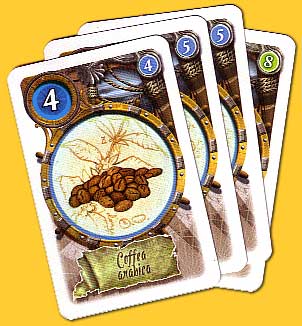
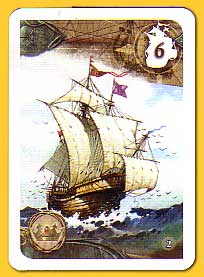
| 20.04.12 We are Spanish ship owners in the 16th century, hunting for the treasures of the New World. We try to increase our business empire by lucrative trading, with the final goal to become as rich as possible. That's the theory, but in practice we are dealing with ten different cards with goods. Each round we receive five cards, and the trade master determines how many of those we will trade: 2, 3 or 4. These cards are placed face open in front of all players, and the trade master opens by taking a card from an opponent. He may either add this card to his hand, or exchange it with a card from the open market. Then, the player where he took a card in turn takes a card from somebody else, and this continues until all face-up cards have found a new owner. Then, players may use their cards to obtain gold, or development cards. Development cards are paid for using combinations of identical cards. There is a complex table that shows how many of what cards entitle a player to which development cards. For example, three 'two' cards allow a player to take only the first of the five available development cards. With four two-cards he may choose from the first three development cards, and with five two-cards he may take any of them. But how different this is with nine-cards instead of two-cards: with three nine-cards, a player can already select any development card he likes. Obtaining gold is more straightforward and requires combinations of different cards. One card for 3 gold, five cards for 25 gold. Any leftover cards have to be discarded: the next round everybody starts again with five cards. The game is over when a player has collected either 75 gold, or all the 10 different cards. But hey, how can you collect 10 cards if you receive only five cards and you have to discard everything you have left? Simple: using the development cards. There are warehouses that allow players to keep one or more cards for the next turn, and ships that yield one card each turn. This way players can slowly increase their number of cards. Slowly, because the 45 minutes on the box is a very optimistic estimate. Especially the trading phase is long and tedious; there's a large number of virtually identical cards on the table, and it doesn't really matter which card you take from whom. And if you happen to be looking at your cards for a moment, you have missed who took what and whose turn it is. It is a lot of unnecessary hassle, there must be more efficient ways to improve your hand, which is basically what this phase is all about. The game is confusing at times: the cards, icons and tables are not at all self-explicatory. Add to this that there is no player aid included: the players all have their own set of rules to consult the aforementioned table and the functions of the development cards. Luckily five rule booklets (in five different languages) have been included... Barbara van Vugt Mundus Novus, Bruno Cathala & Serge Laget, Asmodee, 2011 - 2 to 6 players, 14 years and up, 45 minutesxxtop |
  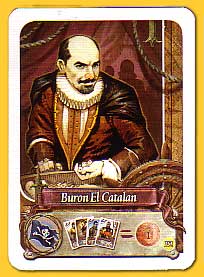 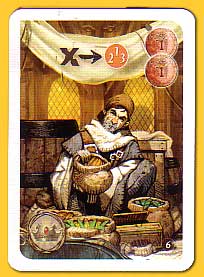 |
||||||||||||||||||||||||||
| x | |||||||||||||||||||||||||||
|
Macao | ||||||||||||||||||||||||||
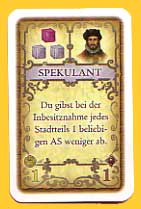
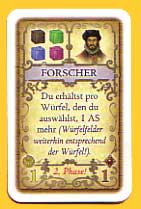
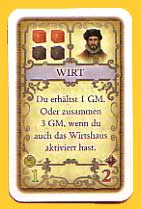
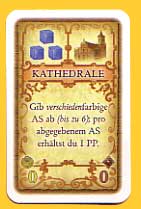
| 24.11.09 The disclaimer at the start of the rules states that because of game technical reasons the topological setting could not be fulfilled. This suggests that the rest of the game must be very close to reality! Subsequently a player must take a card and place it on his board; why this is obligatory and what the board depicts, remains unclear. The card on the board cannot be used until it is placed aside - feeling a bit adverse - but still it is not activated; hmm, this sounds exactly how things went back there in Macao... Six coloured dice are used what and how many AS - which stands for action cubes, probably the local currency - may be taken; with these, cards can be played away from a players board or, when they are already off and next to the board, activated and used according to the text on the card. There is a penalty for players who have not enough room on their board when a card must be placed, and there is a penalty too for players who at game end still have cards on their board. A player is also punished when he cannot perform an action. Yes, Stefan Rat (Notre Dame, Im Jahr des Drachen) must be fond of some punishment! With AS cubes and GM chits - Alea has switched to the American habit of using cryptic abbreviations - more things can be done. The game lasts twelve almost identic rounds, and each player is sitting sighing behind his register. The roll of the dice determines the actions, so do not think any strategic intelligence is involved. One merely has to make shift with what one has, and, speaking of which: the wooden ship tokens usually are moved with the AS left overs. Only from the middle of the game the ships begin to arrive on their location and unload their wares that curiously can be loaded even when at full sea, and finally exchange them for PP - prestige points. Barley dry and little game fun is how you could characterize 'Macao'. Or: very long - four players need an hour or two to complete the game. Or one could compare the players with auditors checking the annual account... Macao, Stefan Feld, Alea/Ravensburger, 2009 - 2 to 4 players, 12 years and up, approx. 90 minutesxxtop |
    |
||||||||||||||||||||||||||
| x | |||||||||||||||||||||||||||
|
Montego Bay | ||||||||||||||||||||||||||
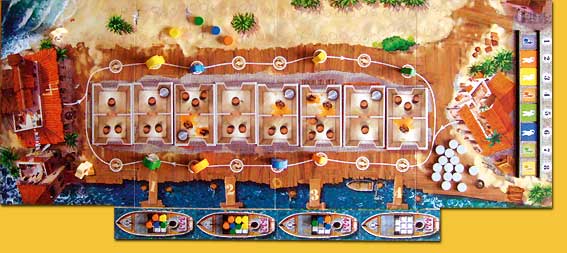
| 11.06.09 Move workers, claim barrels, ship and score points for them; that is what Montego Bay is about. The tokens are moved by playing cards that all players simultaneously choose from their own hand of cards. As a worker can be displaced by other workers and thereby end its move on a less lucrative place, players often will have to estimate what card other players will play in order to still get to the wanted position. When each player has moved his two workers, the positions at the barracks are worked, the barrels claimed and the equivalent in cubes loaded on the ships. When a ship is fully loaded it is scored: the majority gets the most points, the rest less or nothing. Full ships instantly leave the harbour, but at the end of a round the frontmost ship, fully loaded or not, also leaves and is scored before taken away. At the start of a new round already present ships move to the front and the empty spaces are resupplied from a stack of blind ship tiles. When the stack of ships is empty and only three ships are left in the harbour, the game ends. And? What do we think of it? Well, reactions were lukewarm, even by those who normally like the lighter kind of game. The box states the game can be played by eight year old players, but a child of that age is not able to empathize what other players are up to, so it solely will choose its card on the amount of fields it wants to move, without taking possible disruptive actions into account. An minimum player age of ten years would be more realistic. The excessively large executed game board wants to impress like a peacock in mating time but cannot hide the fact that it carries yet another 'guess what the other player is up to' or 'get the majority' game. Often such mechanisms are part of a game, and not the entire game. For young players this game is too difficult, for the rest of us too little challenge lies ahead - we say: it falls between two stools. Montego Bay, Michael Feldkötter, Queen Games, 2009 - 2 to 4 players, 8 years and up, 45 to 60 minutesxxtop xxx |
 |
||||||||||||||||||||||||||
| x | |||||||||||||||||||||||||||
|
Livingstone | ||||||||||||||||||||||||||
| 09.03.09 We set sail on the Zambezi river, and meanwhile place a few tents along the shore or further inland. From time to time we grab from a bag in hope to collect valuable gems. Because the player with the most money may win, but the one with the least certainly does not! Well, that was it, there's nothing more, please move on! Oh, you wanted to know more? The long version? 'Livingstone, born poor and already as a child working fourteen hours a day in a cotton mill but full of perseverance and with a strong wish to become a missionary, first wanted to go to China but ended in Africa to bring the word he believed to be the only truth...' Eh, well, the somewhat shorter version maybe? Livingstone had nothing to do with gems, that was not the reason for him to be were he was. And he only partially sailed the Zambezi as the river was not suitable for boats, so the majority of his expeditions, sometimes as long as 5000 kilometres, he went on foot, adjusting his goals such as finding the source of the Nile which he did not find, by the way. Shall we just discuss the game then? Each turn the starting player throws twice as much dice as players participating; they are conveniently placed in increasing order. In a turn, a player chooses one; the number indicates in which row he may place a tent; the boat, each turn moved a position to the right, indicates what it costs to place a tent, from one to six money. Higher rows earn more money, but at the end of the game a player scores for each row he has a majority of tents in, so scoring now or later, what difference does it make one would say. The die also could be used to take some stones from a bag; the number of the die is the amount of stones that may be drawn. Black stones are worthless, but the others are gems and can be exchanged at any time for money, for instance to pay for the placement of a tent in a future turn, or, not unimportant, to put some money aside and put it in a chest. Regardless of the number of the die, a card can be taken; in fact these are always nice as they can be used for special actions in a turn. When all players have chosen a die, there is a second round where players may take a die but this has to be of a higher number than the one first chosen. This can become quite nasty if the roll has lots of equal numbers! The game is over after the round where the boat has reached the last column. Now the final score is done where players may reveal score cards, and after which all chests are opened; the player who has the least money is out of the race; from the remaining players the winner is the one with the highest score. The end. Winner happy; the rest, as usual, murmur something like 'luck of dice'. 'Livingstone' quite obviously falls in the category: 'When The Crisis Hits Us Hard, The Games Come Light'; as its lightness almost makes it fly away! Yet it is a nice game, easy, light-hearted, not asking too much attention making room for the casual table chat. After a hard day of work in the cotton mill this is the diversion many possibly seek; and we don't have to set out for Africa as thanks to men like Livingstone it is known territory by now! Livingstone, Benjamin Liersch, Schmidt Spiele, 2009 - 2 to 5 players, 8 years and up, 30 - 45 minutesxxtop |
 |
||||||||||||||||||||||||||
| x | |||||||||||||||||||||||||||
 |
Monuments | x | |||||||||||||||||||||||||
|
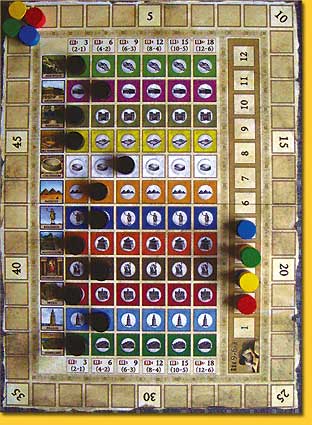
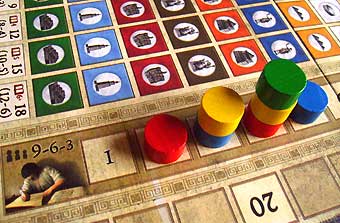
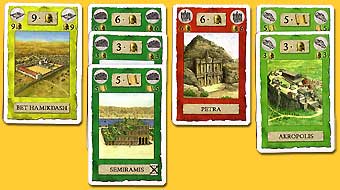
23.01.09 The cover shows a writing youngster; at first glance we think he is wearing a pyama and is making his homework for the other day with the help of some lamplight. But he is not writing at all and we don’t see any homework; he is drawing and the subject is old civilisations and their monuments. The two to four players are going to collect these monuments that come in cards, and similar to the cover illustration they are going to do something with it as well, write a paper about it or something, to bring these monuments under the attention of mankind and in this way increase their regard - but in the game more important to the players: their value. |
|
||||||||||||||||||||||||||
| x | |||||||||||||||||||||||||||
|
Medici vs. Strozzi | ||||||||||||||||||||||||||
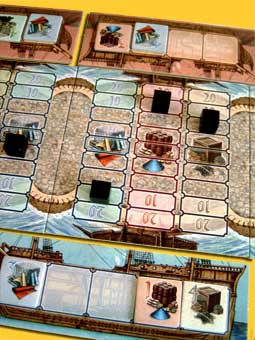
| 21.10.06 Playing boardgames has the side effect that it gives you a nice insight in the different cultures of various social positions. In this two player game for instance we may call ourselves relatives of the patrician dynasty Medici or Strozzi, with our contestor temporary member of the other house. Our goal is to acquire goods at a reasonable price and to deliver them in three different harbours, hopefully with profitable revenues. Each of the three harbours has a different demand in type of goods, but some of the goods can be unloaded in two harbours. Each player has three ships of varying size that, once loaded with one or more goods, must be dedicated to one of the harbours. At the start of a round the starting player draws from one to three goods, and calls a price. The other player may take the goods for this price or passes, after which the first player must take these goods for the called price, the money being paid in the bank. The goods are loaded onto one single ship, divide them over more ships is not allowed. The player that took the goods may draw up to three new goods, but never more than the maximum that will fit on one of his own ships. When the ships are fully loaded or when the goods have been used up a round has ended and scoring takes place. In each of the three harbours the goods of both players are counted, the larger number in value (not chits) gets the bonus of 20 money. Then, for each good, a central marker is adjusted one space. When a marker is on a player's side, he gets 10 additional money. When the marker hits the bonus zones '10' and '20', these extras are also paid out. After this the goods are cleared away, the ships leave the harbour, and a new round begins, but the markers stay in their adjusted position. This may make some goods more attractive to a player. After a third round and consecutive scoring the player with the most money has won. In general, bidding games for two players do not work, but here we find an interesting mechanism that we also know as 'I cut the pie, and you decide which slide to take'. If the amount called is too high, that player must take the goods himself. Not bad if he can use them - throwing them away is possible but not effectively adding to the revenues! But sometimes it is advisable to pay the price, if only to become the starting player and have a say on how many goods will be drawn. When the other player only has space for one good, of course you will draw two or three! It is all this that makes 'Medici vs. Strozzi' a very enjoyable little game. Medici vs. Strozzi, Reiner Knizia, Rio Grande Games / Abacusspiele, 2006 - 2 players, 10 years and up, 30 minutesxxtop |
 |
||||||||||||||||||||||||||
| x | |||||||||||||||||||||||||||
| x | |||||||||||||||||||||||||||
 |
|||||||||||||||||||||||||||
 |
|||||||||||||||||||||||||||
 |
|||||||||||||||||||||||||||
| x | |||||||||||||||||||||||||||
 |
|||||||||||||||||||||||||||
 |
|||||||||||||||||||||||||||