| x | |||||||||||||||||
 |
Five Tribes | 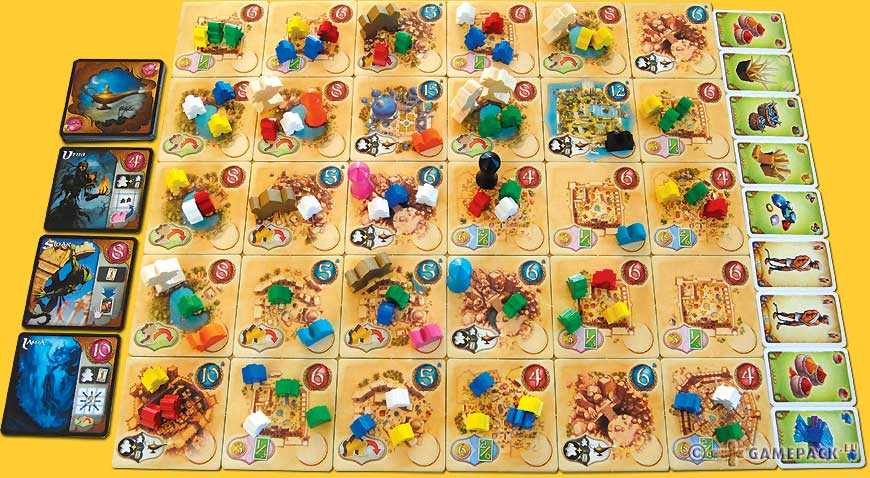 |
|||||||||||||||
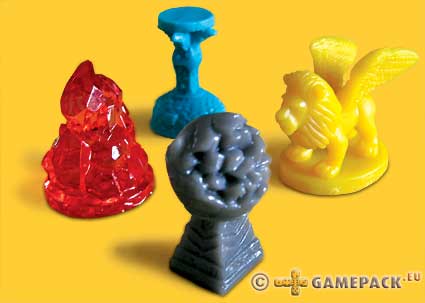
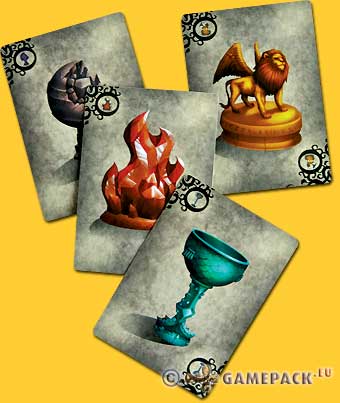
| 06.11.15 In a Tales of the Arabian Nights-setting we travel across the desert and attempt to control the Djinns. With the Djinns on our side, we will definitely succeed in becoming the next Sultan! The board consists of a grid of 5x6 tiles, showing villages, oases, markets and temples. Three random meeples are placed on each tile. The meeples come in five different colours: the Five Tribes from the title. Each colour represents a tribe with their own unique characteristics. In his turn, a player takes all the meeples from a tile of his choice, and he moves orthogonally across the board by leaving behind one meeple on each tile he visits. The final meeple has to be placed on a tile that contains at least one meeple of that colour. Subsequently, all meeples of that specific colour are removed from the tile, and the corresponding action is carried out. For example, the blue meeples allow a player to take money, the green meeples bring resource cards, the yellow meeples score points at the end of the game, and the white meeples can be used to gain or activate Djinns. Additionally, the player carries out the action that belongs with the tile where he ended his movement; purchase resource cards, gaining Djinns, or placing a palm tree or palace. It is possible that a tile contains meeples of one single colour only; if a player ends his movement there, and all meeples of the same colour are removed, this tile is emptied. The empty tile is claimed by the active player: he places a camel in his colour on the tile, and at the end of the game he gains the victory points depicted on the tile. Palm trees and palaces make the tiles even more valuable. Djinns also score points, but their special abilities make them even more attractive. For example, there is a Djinn that allows a player to claim any empty tile, or to place a palm tree anywhere on the board, or to get a discount when bidding for the player order. Five Tribes is one of those games where you sometimes neglect to do something that would have been favourable for you, only because it would leave an even more favourable configuration for your opponents. It can be very important to be starting player; if you see something interesting on the board, being first in line is the best way to assure that the situation is still unchanged by the time it’s your turn! Five Tribes is a puzzle game where it’s completely impossible to oversee everything, and equally impossible to NEVER leave a nice opportunity for your opponents. Five Tribes is definitely an interesting game, for those who can live with such uncertainties! Barbara van Vugt Five Tribes, Bruno Cathala, Days of Wonder 2014 - 2 to 4 players, 13 years and up, 40-80 minutes.xtop  |
|||||||||||||||||
| x | |||||||||||||||||
|
Das Vermächtnis/Legacy | ||||||||||||||||
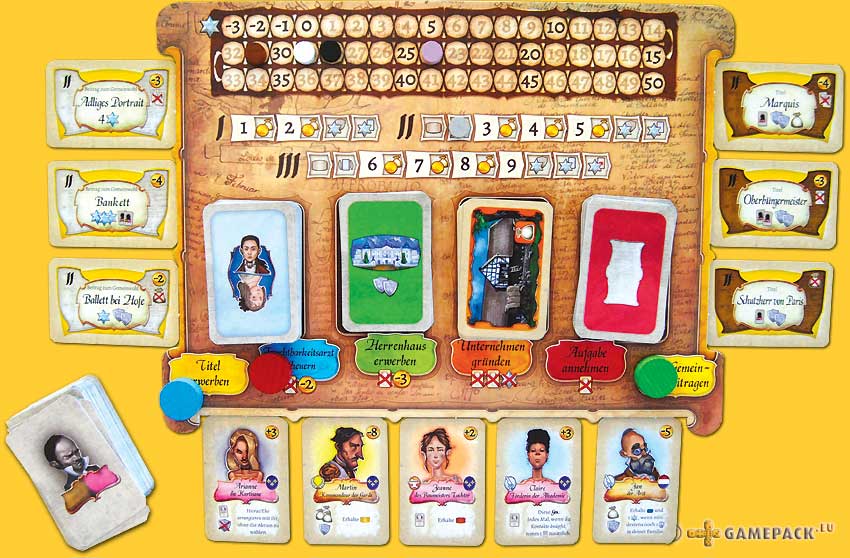
| 05.10.15 In early eighteenth-century France our goal is building an impressive family tree, in order to make sure our dynasty is strong enough to endure all challenges (luckily we are still blissfully unaware of the impending challenge of 1789). Legacy is played over three generations, each consisting of an increasing number of rounds. We start the first generation as a lone patriarch or matriarch, with the prime goal being to get married and have children. In the second generation we strongly influence the fate of our children, and the grandchildren are not safe from our meddling either. Whoever is inattentive enough to end the first or second generation without any offspring is (deservedly!) out of the game. During the game we try to increase our income, which is paid out in cash after each round, and our prestige, which is converted to victory points at the end of each generation. Each player start the game with a secret patron, some money, a small starting income and a handful of friends: these friends can become part of our family through marriage. Legacy is a worker placement game where each player has a personal player board with actions he can perform as often as he likes within a round: one of the most important ones is having a family member from the current generation marry a friend. Directly after marrying the happy(?) couple have their first child! This action can also be used to arrange a marriage for one of the children, which will come into effect as soon as they reach adulthood (i.e. at the start of the next generation). The other possible personal actions are having additional children (with a maximum of three children per couple), ask your friends for some financial help or making new friends. As mentioned these friends are primarily marriage material: each card shows the benefits and/or drawbacks of marrying that person. There is also a central action board, but these actions can only be performed once per round: first come, first serve. These actions allow us to acquire a noble title or make a contribution to the community (both of these generally increase prestige), hire a fertility doctor in order to have two children at once, buy a nice mansion for additional prestige, start a business venture for additional income, or undertake a mission. The mission cards work in two different ways: in the first two generations they are challenges that can be fulfilled for a certain reward, in the third generation they can be used to unlock additional ways to score points from your patron. At the end of the game everyone receives victory points dependent on to what extent they have fulfilled the requirements on their patron card. By introducing the rarely seen mechanism of building a family tree, Legacy manages to give the heavily trodden theme of French nobility an original twist. The interaction is mainly confined to the central action board, other than that everyone will mostly turn their gaze to their own family tree. With four players in the third generation it is pretty much impossible anyway to keep a clear view on your opponents’ families. There are some rough edges in the game: for example, if you’re second in player order at the start of the third generation, you can snatch up two of the lucrative titles or community contributions in the first two rounds. However, this does not detract from the fun that can be had by weighing the pros and cons of all your friends and building the perfect family. Ugur Donmez Das Vermächtnis/Legacy, Michiel Hendriks, Pegasus Spiele, 2014 - 1 to 4 players, 10 years and up, 45-75 minutesxtop |
 |
||||||||||||||||
| x | |||||||||||||||||
 |
El Gaucho | 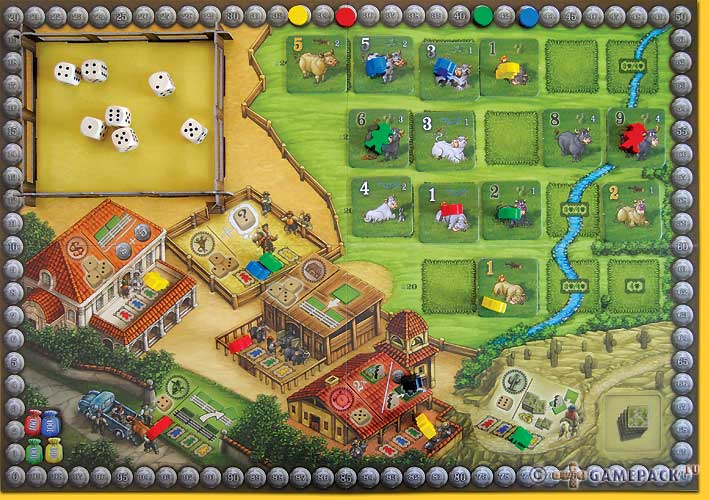 |
|||||||||||||||
| 02.10.15 In El Gaucho we’re not master builders in Tuscany, nor are we traders that sell cloth and spices from our warehouses; no, we are just dusty old cowboys that drive cattle. At least this is a theme that hasn’t been completely worn out yet. Top left on the board there’s a Dice Rodeo surrounded by fences, where the starting player can throw the dice. Each player can use two dice to claim cattle of different values that are grazing in four differently sized pastures. Each cow has been branded with a large number, and a smaller (lower) number. The number on the dice has to correspond to one of these numbers. If it corresponds to the big number, a Gaucho is placed on the tile standing up, but if it’s the lowest number, the Gaucho is placed laying down. As soon as all the cattle tiles in one pasture have been claimed, only the tiles with a standing Gaucho go to their owners; the Gauchos lying down stay where they are until they are ‘resurrected’ using an appropriate die roll. The empty spaces in the pastures are replenished with new cattle tiles if required. The claimed cattle tiles are sorted by race in ascending or descending order, and thereby form a herd. Each newly claimed tile can be added only on the right side of the herd. This way the players elongate their herds, until they receive a cattle tile whose number doesn’t fit into the herd. At that moment the herd is scored: the highest numbered cattle tile in the herd multiplied by the total number of tiles in the herd. There are some more locations where the Gaucho’s can use their dice; this makes the game easier, but also more tricky. One of the options, the ability to add a cattle tile in the middle of a herd instead of on the rights side, is nice enough. But another option, stealing a cattle tile from another player, is often not really appreciated… And there are more unpleasant actions that are, according to the rulebook, key to victory. El Gaucho is a simple dice- and set collection-game, where you have to accept that the dice will not always be on your side, and where the competition can be nasty. It’s a nice game for a couple of times, but it lacks the attraction to captivate players in the long run. El Gaucho, Arve D. Fühler, Argentum Verlag, 2014 - 2 to 4 players, 45 minutesxxtop |
|||||||||||||||||
| x | |||||||||||||||||
|
Die Baumeister: Mittelalter | ||||||||||||||||
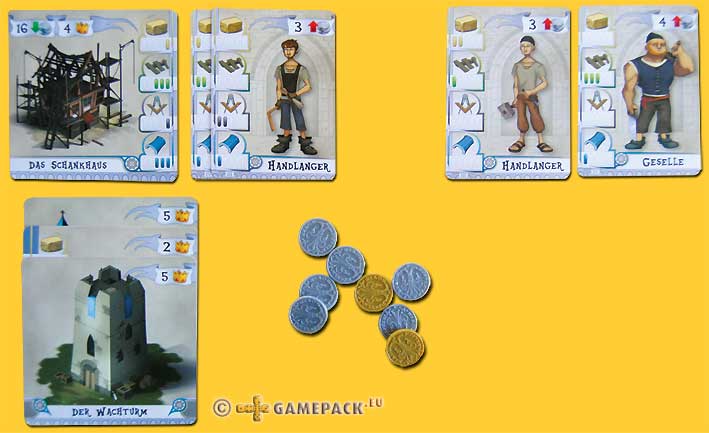
| 02.06.15 In the role of Master Builders, the players attempt to erect as many buildings as possible. The more, the merrier! The builder that manages to construct the most prestigious creations wins the game. The game contains building cards and worker cards. Five of each type are placed face-up on the table. To construct buildings, resources have to be paid. The cards depict how many wood/stone/knowledge/tiles the buildings cost (0 to 5 each). After construction, the buildings immediately earn the owner money, and at the end of the game also victory points. The workers have four different levels of experience; the apprentices have the lowest salary, but they also possess less resources. The masters are the most expensive, but also the most experienced and well-equipped. On his turn, a player performs three actions. The options are: take a building card, take a worker card, allocate a worker to an unfinished building, or pass. These actions may be repeated and combined at will; it is even possible to buy additional actions for 5 coins. If a player takes a building card, the building is considered ‘under construction’. The player can send some of his workers to work on this building by paying their salary to the bank and aligning them to the building. As soon as all the required resources have been assembled at the construction site, the building is considered ‘finished’. He player receives the depicted amount of money, and he turns the building to its finished side (showing the victory points). The workers are now free to start working on another building. Multiple workers can be allocated to one building, but placing the second worker costs two actions, and the third worker costs three actions et cetera. This is only the case if the workers are allocated to one building within the same turn! Placing two workers at two different buildings costs two actions in total. As a consequence, it is advisable to work on multiple buildings simultaneously. This also poses a risk: since a player receives money only after finishing a building, he may run out of money if he works on too many buildings at the same time without finishing any of them. If a player does run out of money, he has to pass. Passing for 1, 2 or 3 actions yields him 1, 3 or 6 coins. As soon as a player has collected 17 points, the current round is finished. The player with the most victory points wins the game! Die Baumeister is beautifully designed and illustrated. It’s basically a puzzle: how to match the demand (building cards) and the supply (workers) in the most efficient way. One should have enough workers to be flexible, but not too many (since hiring them also costs an action!). And there is a delicate balance between small buildings (easy to finish for fast money, but they don’t score many points) and larger ones (score a lot of points, but take multiple turns and a lot of salary-costs to complete). To spice it all up, there’s also your opponents, who have the tendency to take exactly those cards that you wanted to have for yourself. Just like every card game, there is an element of chance. Do the materials on the building cards match the resources on your worker cards? Can your workers be combined to match the building costs exactly, or is it unavoidable to grossly overpay? The building cards score 0 to 7 points; a player that concentrates on the larger buildings can reach the threshold of 17 points fairly quickly. The game is often too short to give a player who has had a stroke of bad luck a chance to recover. But for a card game of 30 minutes that doesn’t pretend to be more than just that, this is no big deal. If somebody complains that he has had an unfair amount of bad luck: just let him have a re-match! Barbara van Vugt Die Baumeister: Mittelalter, Frédéric Henry, Asmodee/Bombyx 2013 - 2 to 4 players, 10 years and up, 30 minutesxxtop |
 |
||||||||||||||||
| x | |||||||||||||||||
|
Die Legenden von Andor - Der Sternenschild | ||||||||||||||||
|
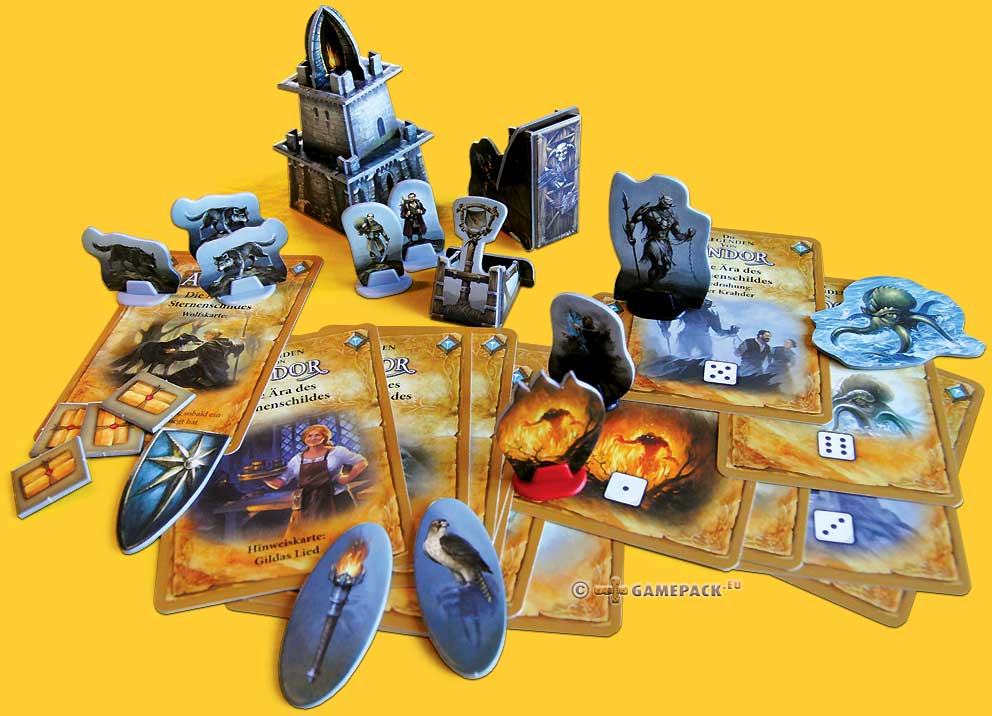
07.09.14 The Andor expansion Der Sternenschild is best described as a new, variable scenario for Andor. Each fulfilled, and a threat has to be annihilated. Just like in Andor, each scenario is composed of legend cards with letters, but of some of the letters, multiple cards are present of which only one is randomly selected. Depending on the specific combination of cards, the heroes will run into very different situations. |
 |
||||||||||||||||
| x | |||||||||||||||||
 |
Expedition: Congo River 1884 | 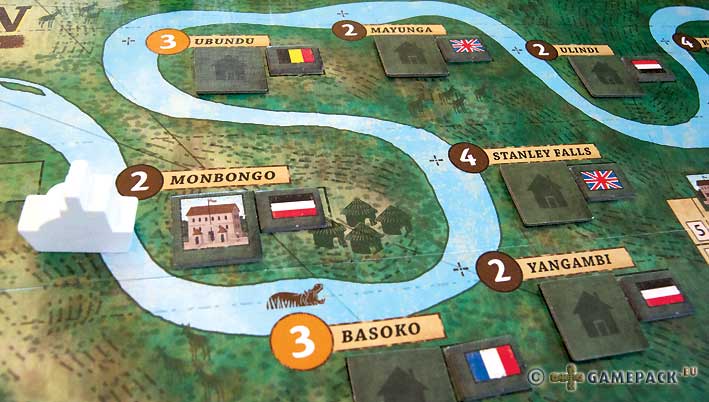 |
|||||||||||||||
|
08.03.13 A steam boat is floating the Congo river; it's the year 1884. Aboard are an illuster travelling company who all are here for one thing: gain power over the blacks. Therefore they travel all the settlements, sixteen in all; first to battle among themselves before the real missionary work can start. Each settlement is characterized by a building of some kind that gives various power to each person in the party, represented by a card in a players hand. Each player simultaneously chooses and plays a card from his hand, after which the value of it is compared on a little grid: 'Oh, an antropologist and a hospital, he's worth three points'. Subsequently players may play socalled helper cards with the same symbol as the first played card, and they continue until all passed. The player with the most points gains power over the settlement, and scores the points of its value. Next settlement! |
|||||||||||||||||
| x | |||||||||||||||||
|
Die Zwerge | ||||||||||||||||
|
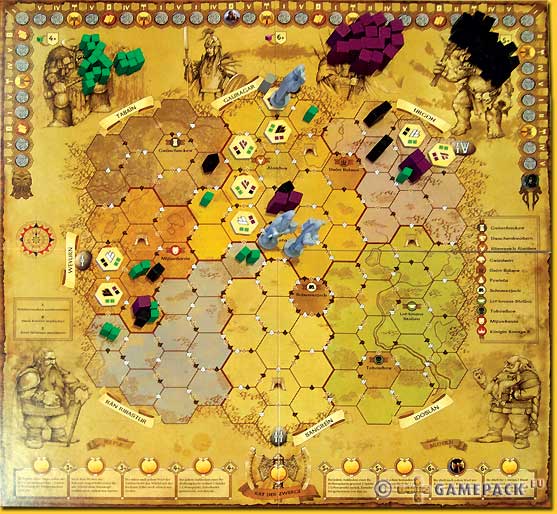
04.12.13 The land of Girdlegard is under attack! Led by the mage Nôd’onn, armies of orcs, ogres and alfar (dark elves) are overwhelming the land, and it is up to the traditional protectors of Girdlegard, the dwarves, to stop them. In the cooperative game ‘Die Zwerge’ fans of the Markus Heitz novels have the opportunity to step into the boots of Tungdil Goldhand or one of his companions. |
 |
||||||||||||||||
| x | |||||||||||||||||
|
Feudalherren | ||||||||||||||||
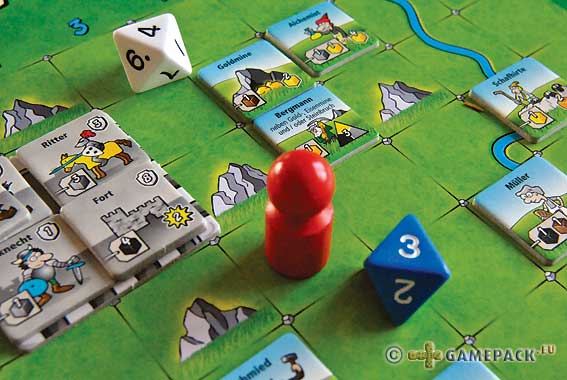
| 19.01.12 Old times are returning! As the chosen ones we may at our own discretion shamelessly exploit a small piece of land. The king is part of the plot also, and he sees no evil in it if only he gets his share of the loot. He does not hesitate to knock on our door again and again with yet another request for contribution or participation in the inevitable but necessary war that must be fought if only for the violated honour. So we get to work: from a window each turn we buy a tile that should provide us income. We place it somewhere in our fenced state-owned tenant farm, and hope the dice are favorable to us. Dice, well, we had not expected this, or did we? The box states it almost as a recommendation: 'Mit Würfeln', with dice, and this continues a games trend that started some five years ago and broke with the taboo of not using dice in 'proper' family games. Since then the scene has seen many creative ways where the dice play a more tactical role. But the two dice in 'Feudalherren' are merely used to pinpoint a location on the map around which one chosen tile, if any, produces one or more resources or scores one or more points. The game ends when a player scores so many points that varies with the amount of participating players. Also each turn an event card is drawn, indicating what kind of requirements the king has in mind for us this time: put a number of commodities on the doormat of the palace, or simply send a chivalrous delegation into war; we get fairly squeezed but al this may score points. Sometimes the king stays at a friend, and players then can read from the card that they breathe easily. The whole game is steeped with the randomness of the dice and the event cards where thoughts immediately go to the famous line 'You won the second prize in a beauty contest' on one of the chance cards in Monopoly; the further livery of the game such as sabotage or going to war essentially is ornamental and plasterwork, and could be dismissed as put-on embellishments. When the game by a lucky throw of the dice finally has ended, it leaves a sour taste in the mouth. We were cheated and fooled; the suggestion that we could play tactically by placing our tiles on the grid at will is not fulfilled -ultimately the dice are the real rulers. Having to live with a volatile king is one thing, but not when at the same time Gladstone Gander / Gustav Gans is making us trip. Feudalherren, Tom Wham, Lookout Games / Heidelberger Spieleverlag, 2011 - 2 to 6 players, 10 years and up, 60-90 minutesxxtop |
 |
||||||||||||||||
| x | |||||||||||||||||
|
Drako | ||||||||||||||||
|
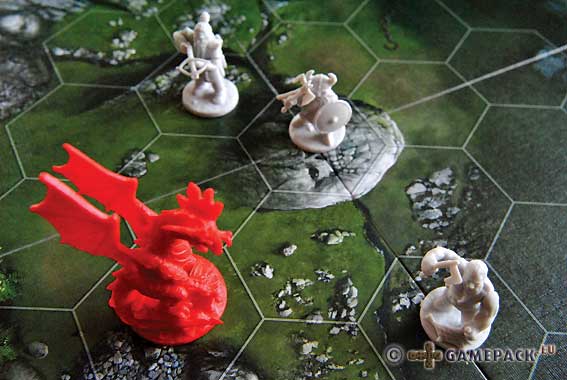
16.01.12 Dwarfs against the dragon! In this beautifully designed 2-player game, one player represents a group of three dwarves, and the other is the dragon. The dragon- and dwarf miniatures are placed on the grid, and the players take turns playing cards to move or attack with their characters. In a players turn, he performs two actions: he may choose between drawing 2 cards or playing 1 card. When more than one symbol is depicted on the card, the player chooses which symbol he wants to use. The dragon can walk (1 step) or fly (unlimited), bite (adjacent dwarves) or breath fire in a straight line (distance unlimited). The dwarves all can walk and attack adjacently, and additionally the dwarf with the crossbow can shoot in a straight line. When a player attacks his opponent, the opponent has the opportunity to play a defence card, or he has to take a wound marker and put it on his player mat. When all wound marker positions have been filled, the character dies and is removed from play. If this happens to the dragon, the game ends, but the dwarves can continue the game with two or even one of them. The wound markers of the dragon are divided over several categories: when the fire breathing-area has been filled, the dragon is no longer able to breath fire. The attacking player chooses where he wounds the dragon. Three against one, that just isn't fair! The dwarves almost always win. The dwarf player has three characters at his disposal, making this the most strategic -and most fun- side to play. For starters, they have more wound marker positions to fill, and because there's three of them it is more difficult to kill one. If one dwarf is at the end of his powers, he can be placed somewhere safe so he won't suffer additional damage, while his brothers take care of the dragon. Additionally, the dwarf cards contain twice as many defence symbols compared to the dragon's! This means that the dwarfs are likely to be able to block a dragon attack, while the dragon almost always has to take a wound marker whenever he's assaulted. There's a hand limit of six cards, so collecting cards in order to have all defence cards ready when needed is not an option... And last of all: it is possible to paralyse the dragon by targeting his fire breathing-, walking- or flying abilities. This renders him mostly harmless long before he is actually dead. But hey, after all life isn't fair, so why should a game be?! And because Drako takes only 30 minutes, you can immediately play a revanche and change sides! Barbara van Vugt |
 |
||||||||||||||||
| x | |||||||||||||||||
|
Die Säulen der Erde - das Kartenspiel | ||||||||||||||||
|
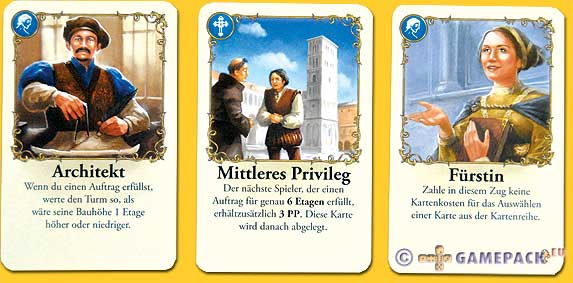
29.10.11 Just like in the board game with the same name, we aim to build the largest cathedral in the world. But this time, we only have a deck of cards to accomplish our goal. The names of the characters sound familiar by now: Aliena and Tom Builder are joining us again! But apart from these names and the illustrations on the cards, the theme plays a minute role. We don't even get to see the cathedral, it is only mentioned in the text on the box. The deck contains five workers in each player's colour, and 15 neutral cards. The cards are distributed evenly amongst the players, and they try to take tricks. In player order, each player places one card on the table, and as usual the highest card takes the trick. But here it comes: if this card was a worker card in a player's colour, this player takes the trick, no matter who played that card! This way you can 'give' another player a bad trick, if you happen to have one of his workers in your hand. When all cards have been played the cards are scored. Each worker in the player's own colour scores 1 point, and each building material card yields the corresponding building material. This is marked using cards that can be turned into their 0, 1, 2 or 3 position. The building materials can be used to score points, provided that the player has won the corresponding worker. A mörtelmischer can convert sand into 2 points. If you don't have sand, the mörtelmischer is useless, but if you don't have a mörtelmischer, the sand can be stored for subsequent rounds (9 or 10 rounds are played). This is taking tricks with a twist; the cards don't have a fixed value, their value depends on your personal situation. The werkzeugmacher can convert metal into 5 points, which is absolutely great if you possess metal, but utterly useless if you don't... Also the fact that other players can use your workers to make you take a trick you don't even want is very frustrating. Anyone who plays this game with experienced players will see that the scores are usually very low, because they're all constantly bugging each other. Since you need the right worker as well as the right building material, and other players can use your cards to prevent you from succeeding, Fate has a much too big role in this game. As a consequence the game is random as well as frustrating. For a card game 60 minutes is relatively long: in 30 minutes more you can play the board game, which is superior in every aspect. Of course it's not completely fair to compare a board game to a card game, but if we were not supposed to compare them, they shouldn't have given them the same name! And yes, the comparison turns out a bit unfavourable for the card game in this particular case. It smells a bit like exploiting the success of the board game. Barbara van Vugt |
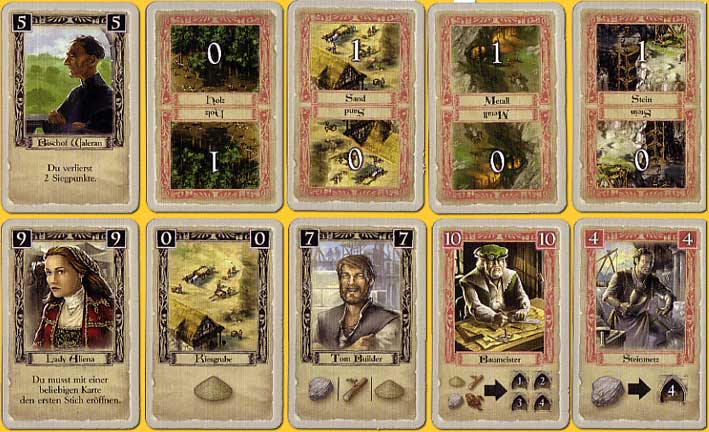 |
||||||||||||||||
| x | |||||||||||||||||
|
Deluges | ||||||||||||||||
|
17.10.11 Deforestation and overpopulation threaten our planet! The former causes terrible floods, and the latter results in dangerous fanaticism amongst our people. That sounds familiar, wasn't there an article about this in the newspaper recently? Although Deluges is set several thousand years before our time, the theme is surprisingly contemporary. Each player leads a civilisation that cuts trees and plunders mines, and on top of this they also reproduce. When the forests and mines are depleted and there's nothing to do for the expanded population, each civilian that has been idle for one round turns into a dangerous fanatic. If the fanatics have the majority in a certain area, this area is forever out of our control. The more deforested areas, the higher the water level rises. When a critical limit is reached, a flood occurs. This happens thrice in the game: the first time the islands are flooded, the second time the coastal areas, and the third time the rest of the world. The players try to use the limited time they have to leave their footprint on the world. They build ships to discover other continents, arrange armies to overpower and enslave their fellow beings, and erect dolmen that will stand the test of time, flood or no flood. And they can also try to at least postpone the inevitable disaster. It is a known fact that it takes two to reproduce, thus, if you spread your people you can control population growth. Trees reproduce in the same fashion, although this is not exactly what we were taught in biology class: two remaining trees in the same area yield a new tree. Sustainable forestry can therefore prevent complete deforestation. But beware: opponents that have failed to adhere to the FSC guidelines will direct their greedy little eyes -and armies- to your beautiful land. When the planet is as good as doomed, the players step out of their difficult roles and count the scores. Dolmen score points, even when flooded, and bonus points are awarded for the majority of this, that, so and so. Although the game idea is nice, it doesn't really come together. There are some moments of chaos, for example when harvesting all players have enough difficulty to keep track of what worker cut what tree or excavated what mine, and which forest is now exhausted, and what workers have to be turned into fanatics because there was no work for them, and as a consequence they pay no attention to each other, which makes this a multi player solitaire phase. This is followed by a phase where everybody is talking at the same time: trading. The mines yield a cube in the colour of the area they are in, so not all players have access to all the different colours. The player with the loudest voice usually manages to get what he wants, and some others will think 'oh well, never mind then!'. The different colours are not absolutely necessary, but they are convenient: when buying armies or buildings you pay less when you use more different colours, for example four differently coloured cubes as opposed to ten cubes of the same colour! Another issue is that the impending danger has a very long lag time but a steep peek: for the first couple of rounds it seems like the earth is never going to flood, but at a certain moment things are going so fast that the civilisations are plummeting to rock bottom. This happens so fast that it can occur that a player suddenly gets stuck: areas in control of the fanatics can not be entered, and if you don't have the right resources for a boat you can never leave the place to make a clean start somewhere else. All in all, the game is unbalanced and chaotic, and also quite long. Barbara van Vugt |
 |
||||||||||||||||
| x | |||||||||||||||||
|
Felinia | ||||||||||||||||
| 03.10.11 Felinia is about trading goods, and that these traders happen to be cats is of no importance whatsoever. But the musical Cats has been running for 30 years now, so apparently people find it an attractive theme! So we have to look at a board full of cats dressed like people... Every round the players place their three action disks: either on a market, to buy goods, or on their player board, to collect 1 to 3 coins. More than one players may place their disk on a market. The top player is the first to buy, but he also has to pay the most: as many coins as there are action disks on the market. After the purchase the disk is removed, thus lowering the price for the players below him. There is also a trading post where undesired goods can be exchanged for other types from the bag. In the harbour of Katzburg (sigh...) five ships are waiting for departure. Each ship contains a ship tile depicting which three goods the ship demands. If a player pays the requested goods, he may place a trader on the ship, but be quick since there are only one or two positions available on each ship! When the ship is full, it departs for Felinia on the other side of the big blue sea. If none of the ships are completely full, the ship with the earliest departure time sails anyway, since those Felinians are an impatient bunch. Once there, the adventure begins! The trader sets foot on Felinian ground, and may move three fields. He collects goodies as he goes, and aims to end his movement on a field with a trade marker. These markers score points at the end of the game. The trader remains in Felinia; at the end of the game, groups of adjacent traders score 1 to 3 points per trader. The game can be rather frustrating when your goods do not match the ones demanded by the ships, when the ship of your choice sails away under your nose, or when you are short one coin for your master plan. But the game offers enough opportunities, and it lasts long enough to be able to use them and get back on track. Felinia is not a heavy strategic challenge, but it is a pleasant and friendly game, despite the not very original or well-implemented theme. The cats trade glassware, wines, watches and books instead of cat food, scratching poles, toy mice and flee collars. The profi version on the back of the board is strongly recommended: it's much more fun! Barbara van Vugt Felinia, Michael Schacht, Matagot, 2010 - 2 to 4 players, 10 years and up, 45-60 minutesxxtop |
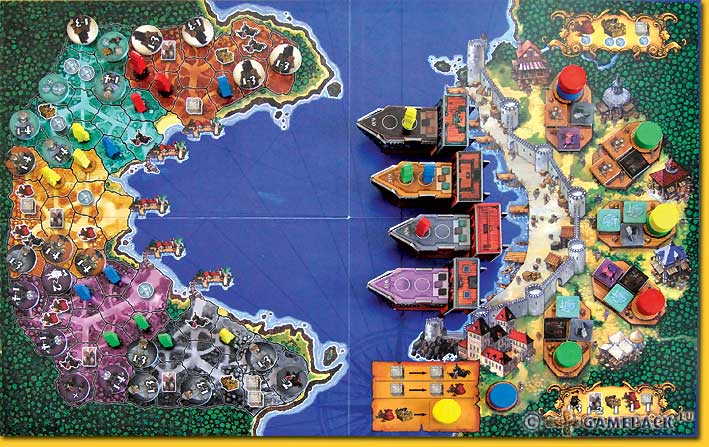 |
||||||||||||||||
| x | |||||||||||||||||
|
Dakota | ||||||||||||||||
| 28.05.11 Indians and cowboys, it keeps occupying the minds. When saying 'Indians', one says 'bisons', and by saying 'cowboys' one means John Wayne. Or something. In 'Dakota' players first choose which club they want to belong to, after which the settlers try to exhaust the natural habitat of the Indians as quick as possible to get to the more important resources, at least for them, while the Winnetous in the game desperately try to maintain the natural balance. But is this true? Because the brave Indians also cheerfully hunt, and through a market mechanism they get to all sorts of totem poles and other nice stuff which brings them points but also costs wood, horses, fish and bisons. So the theme is not quite right here! The game board shows seventeen areas that gradually get discovered and resource-wise exhausted. Each area has two rows, the upper is more attractive to the Indians, and the lower more attractive to the settlers. But not quite. All hunted, captured, harvested or cut items can be sold at the market where other items can be bought. Indians get a different price but this is not because out of discriminatory motives as the settlers too would like to get better prices for some -but yet different- items. Generally can be said: what is of interest to one side, is of less interest to the other side. The second row in an area only becomes available until the upper row is depleted -but only from the next round. Therefore the settlers want to hunt down the bisons as quick as possible although they do not have much to it, being quite in line with history here. Collecting the resources is done by alternately placing pawns in areas of a players choice. After the initial placing round a second round follows in which neutral pawns are placed that can be allocated to either side. As only the majority of a side, Indians or settlers, may pick the fruits of the fields, these neutral pawns can be used as nasty obstructors, especially in the knowing that neither side gets anything when sides are tied. Each winning player takes a number of resources equal to the placement of his pawns, unless the row gets depleted before he can take anything -bad luck then! The game lasts, dependent on the amount of players, eight to ten turns during which each player tries to get what he can get. Ambivalent choices are made: 'When I place a pawn here I probably get no competition as what I want most, I certainly will not get'. Points are scarce and actually only come from bought extensions as totem poles, a fort or a saloon. Each of these extensions give a small advantage such as the blacksmith that earns two extra money each time when a player sells metal at the market. For twelve money a player can buy a victory point and this could be a possibility near the end of the game to win by a nose but usually this money can be better spent elsewhere. 'Dakota' gets a bit stuck by placing meeples and gaining majorities in areas. But actually there is little depth and no progress; after each round all pawns go back to the players. This way the placing and collecting gets a bit repetitive and causes little tension. Althought the game is nicely executed, including a beautiful rulebook that covers everything, we had the misfortune that the opulent produced game board instantly broke when trying to (gently!) bend back a fold. It was the heaviest emotion that this game brought us, really. So, we just disengage from this game. Dakota, Piero Cioni, Tenki Games, 2010 - 3 tot 5 spelers vanaf 13 jaar, 60 minutesxxtop |
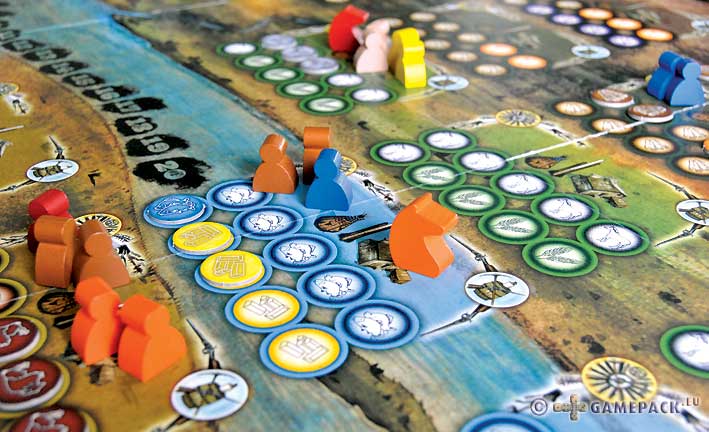 |
||||||||||||||||
| x | |||||||||||||||||
|
Forbidden Island / Die Verbotene Insel | ||||||||||||||||
|
Players are dropped as a team on an island, which is doomed to disappear in the waves. Four treasures need to be collected, before players meet-up at the 'Fools Landing' site where they will be picked up by a rescue helicopter. This is the only way to save their lives and win the game. |
|
||||||||||||||||
| x | |||||||||||||||||
|
Fürstenfeld | 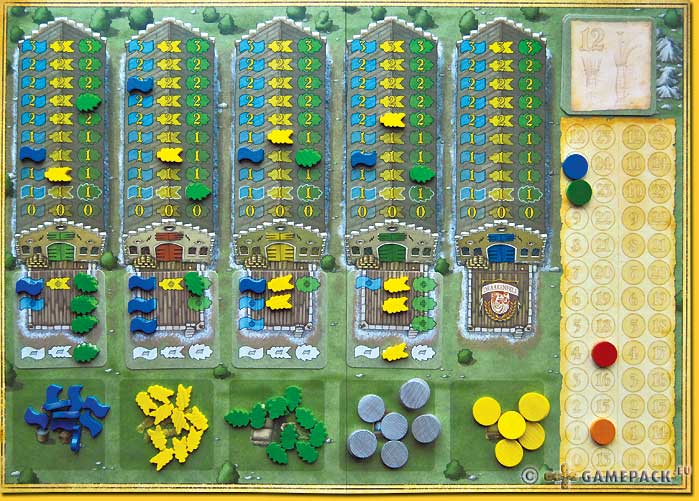 |
|||||||||||||||
| 31.12.10 Collecting resources and sell 'em, we haven't done that in a long time! Each player has his own field from which he may harvest, and with the help of a pile of cards from which he may choose any one of the first three, he continues building and in this way improves his production and income. The resources are offered at various breweries through which prices may change. Income is important as there are six palace parts between the cards and these have to be built within a stipulated time, eventually on fields where water was inflated, barley was grown or trees were cut. Deadline of the project: just before the other players have completed their palace, as only then victory can be claimed. At the start of the game demand cards are placed at the breweries which suggests these variations in price matter a lot. But the differences are marginal, it is not that a player will think: 'Wow! This is going to be a challenge!'. The same goes for the varying revenues when the resources are brought to the brewery: prices swing a bit, but do not cause a major shock wave through which a player would receive substantial more money than any other player. Ripple, that's what the game does. A player eventually becomes desinterested by this. And then a game feels long, despite its 60 minutes. That the wooden components have reached the lower limit of our haptic abilities as they are too thin to pick up conveniently, and that the game board is not properly supported by the inlay so it bends in time, is less important, then. Fürstenfeld, Friedemann Friese, 2F-Spiele, 2010 - 2 to 5 players, 12 years and up, 60 minutesxxtop |
|||||||||||||||||
| x | |||||||||||||||||
|
Firenze | ||||||||||||||||
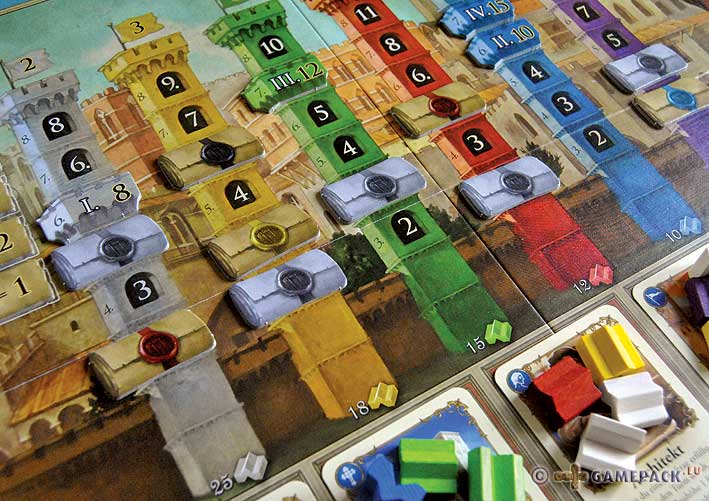
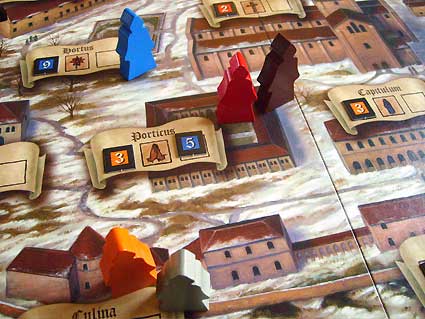
| 10.11.10 Building tall towers just for the show is of all times, and in 12th century Florence they particularly made good sport of it. The skyline of the city counted numerous towers many of which were up to 70 meters, erected by rich families who this way wanted to boost their class some more. Unfortunately through this high-hatted behaviour not all went well during construction, with a pile of collapsed rubble as an unwanted result. In 'Firenze' players will try to rebuild this skyline, at the same time taking care none of their towers will collapse. Each turn a player chooses one of six face up cards from the window - on each card initially four, later eventually more, randomly drawn construction parts in six possible tower colours are placed. The first chosen card in the row is free, but for instance when a player wants to take the third card in the row, he must place a construction part on each of the skipped cards, in a colour of his choice, from his personal supply. The cards give additional possibilities during construction, but can also have annoying consequences - for an other player, but also for the current player. Aha! So that's why cards are skipped! Ofcourse the nasty card gradually gets more and more attractive each time it is skipped and a new construction part is placed on it. Another reason to skip a card could be that there are badly needed construction parts of a specific colour on a card further right in the row, as building on a tower each turn practically is mandatory. When a player is not able to build any further on a tower, it collapses and the player must return his parts to the general supply: a cloth bag from which four construction parts are drawn each time the window is refilled with a new card and placed at the far right. As a last action in a turn, a player can declare a tower finished and exchange it for prestige points as stated on the corresponding tower. In fact a player does not build finished towers but he merely exchanges the construction parts of a specific colour, in a level of the same height of the corresponding tower by placing his seal on it and scoring the points.. When any player has placed all his seals on the towers a last round is played; finally a bonus per tower is given for each player with the most seals on it. 'Firenze' can be quite nasty when players snatch aimed construction parts away for others and make them look foolish, or when a player is confronted with a pesky card that he is unable to skip because he does not have sufficient construction parts in his suppy to redeem it. And building isn't quite free either! Only the first two construction parts in a turn can be built for free; additional ones will have to be paid for: with construction parts! All this adversities aside, fortunately there are cards that give extra's too, as being able to build an additional and free part, or the exchange of parts for a level higher or lower of a tower. The higher the level, the more points it scores, so why would a player want to claim one lower? Well, because: gradually the levels of the towers get constructed, and the corresponding level could already have been built and occupied with a seal of another player (or himself) in an earlier turn. Claiming a lower level then is an option, provided the player has the special card to play with it. Minor minos point of a further beautiful executed game: the text on the cards is not readable from any position and its meaning is also not supported by symbols. 'Major' minus point: the cards have marvelous illustrations made by Michael Menzel but on this spot of the card the construction parts are placed, with the consequence that we are not able to admire the illustrations anymore! At first sight 'Firenze' looks like the ordinary 'collect, build and score' game. But through the element of weighing which card with what construction parts to take, the risk of collapsed towers and the ability to bother other players, it rises from this level and gets quite more vicious. This makes it suitable par excellence for constructive, calculating ànd daredevelish players who can stand a good deal! Firenze, Andreas Steding, Pegasus Spiele - 2 to 4 players, 12 years and up, 45-90 minutesxxtopxx |
|
||||||||||||||||
| x | |||||||||||||||||
|
Fresko | ||||||||||||||||
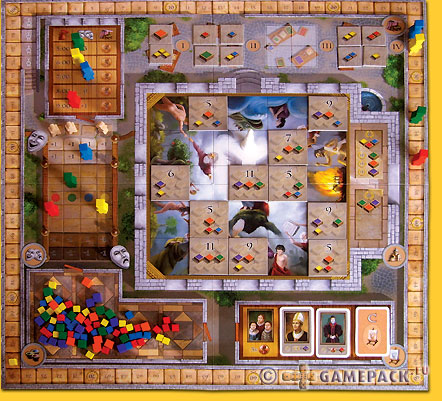
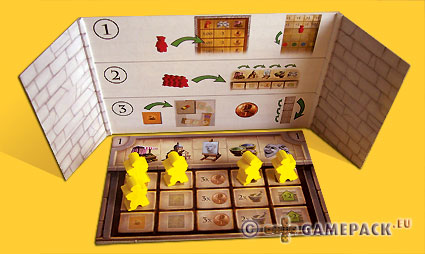
| 18.03.10 This time the authors let us practise a very unhealthy profession: lying on our back on a ramshackle scaffold, working with zinc, lead and cadmium holding paint, all this to paint a wonderful fresco on behalf of the local clergy. Our reward: a short life but eternal fame, and a bevy of twenty first century tourists who marvel at our painted spectacle, meanwhile ignorantly using the flash lights of their cameras, thereby helping it to perdition. Well, we sign for that! In the morning we impel ourselves from our beds to go to the market and buy the dye for the paint; near the closing of the market prices gradually fall but experience tells us that we have to settle with dented fruit i.e. left overs; this is how the market works. So we have to get up early, but we get moody from that, and too much shortage of sleep makes us less sharp with the consequence that eventually we have one worker less to employ in the action phase. During this phase we determine how many dye we buy, with how much manpower we work on the fresco today, or, when we have become a bit short in cash, if we will have to do some necessary model work at the studio.Further we can process the dye into paint at the workshop, occasionally mixing colours, and everyone who (still) knows Bob Ross will immediately know what we are talking about, yes, right: Van Gogh Brown. Finally, to keep our mood up to the mark, we may choose to spend an evening in the theatre, yes, George Carlin has his contemporary and dispersing pendant in each and every era! Each of these chosen actions are worked per action, and per player. A player who got up early has the first right to work on a certain spot in the basilica, a five by five grid of tiles with on each tile the required colours and the points it scores. The basilica is the domain of the bishop; a player will want him in his vicinity when he is at work as this display of skill earns extra points. When there are six tiles or less, there is a last phase after which the game ends. The game has a nice tension; the market stands each round have a different mix of resources, and despite the fact that each player has his own palette of colours to mix, there certainly will be stands that are desirable for more than one player. Getting up early is the motto, but this choice initially is determined by the player’s scores: the player with the least points may choose first at what time he will get up. This player order also is important in the basilica, where ‘nice’ tiles can be snatched, especially for tiles where the bishop is near. To think out the best move, each round nice considerations are to be made. ‘Fresko’ follows the known path of collecting stuff to do Something Important For Points, with the occasional beckoning side track that quite contradictionary has to be followed for a player’s progression. Yet this mix gives enough tension and interaction. And for those who want to play a somewhat more complex game: three free of charge included expansions offer additional challenge for even more hours of fun! As an aside, and completely irrelevant for gamers: the new design of the Queen boxes have an appealing appearance and provide mutual support in a shelf position. Back to relevance: in this very well produced game even the player’s screens and action sheets are of nice thick card board! Fresko, Marco Ruskowski & Marcel Süßelbeck, Queen Games, 2010 - 2 to 4 players, 10 years and up, 60 minutesxxtop |
  |
||||||||||||||||
| x | |||||||||||||||||
|
Die Speicherstadt | ||||||||||||||||
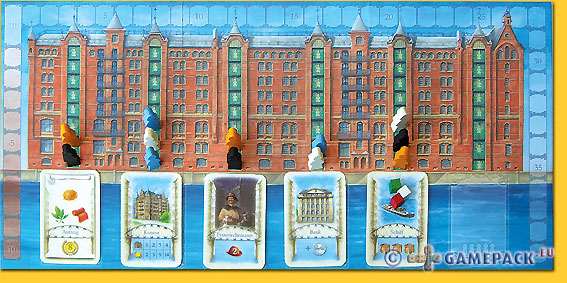
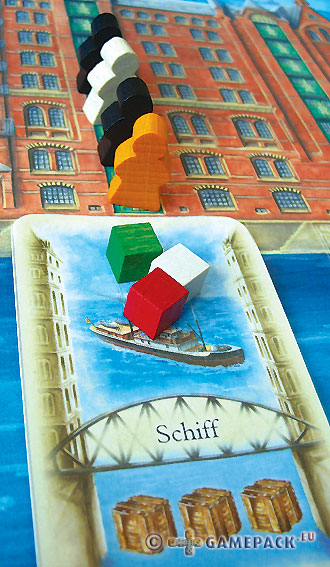
| 07.03.10 It’s cube management time again! In a round, depending on the amount of players, three to six cards are drawn and placed face up below the warehouses. If there is a ship card among these, three goods cubes are randomly drawn from a cloth bag and placed on the ship card. The starting player now places one of his workers above a card of his choice, on the lowest level of the warehouse. Any other player may also opt for this card, but must place his worker above any other worker present. A player even may place more than one of his workers in the same warehouse, but he has only three workers available to him. When all players have placed their workers, the cards are worked from left to right. The player with the bottom most worker now has the option to obtain the card if he wants to pay for it: as many coins as there are workers present above this card. If he does not want to, or is not able to pay, the next player is given the opportunity to buy, the card now being one coin cheaper. This could continue till the last player having to pay only one coin if other players are not willing or able to pay. When all warehouses have been worked, players now unload the goods from their ship cards and place them either on an assignment card, sell any or all of the goods through a salesman, store them in a warehouse, or exchange, sell or store them in his market hall. Any or all of these options may be performed. The assignment cards when full, score the indicated points at game end. A player can acquire additional storage through a warehouse card that can hold up to four good; his starting card the market hall can only keep one good. Several salesmen cards enable a player to sell goods for money. There are several other cards that score points in various ways at game end; for instance the harbour scores one point per ship card in possession; or the church, scoring four points. Players who did not acquire any card in the actual round receive two coins, all others one coin. A following round is started with placing new cards below the warehouses. There are four 'fire' cards in the game. When a fire occurs, players count the value of their firemen. The player with the highest value gets the value on the ‘fire’ card in victory points; the player with the lowest value decreases his points with this value. After the fourth fire the game ends. In the bidding phase, players can hinder each other by intentionally placing a worker in a warehouse to increase the price of the card for another player with an additional effect: the biblical ‘the last will be the first’ becomes very true, as when no player is able or willing to pay (dearly) for the card, the last player can buy it for only one coin! The cards are divided into four stacks, and after a few plays players will recognise when certain cards will show up. The fires always occur somewhere in the second, third an fourth stack, with a final fourth fire at game end. The effects of the fire cards can be very violent, and with values from one to four can work very unbalanced: at game end one player will score four points because he has maybe only one more fireman than the other players, while one or more players have to substract four points. That is a lot in a game where the assigment cards have values from five to eleven points! Also there is a feeling that the player with the fewest firemen during the third fire will most certainly also be the one with the least firemen at game end; thereby facing two times the penalty of a minus score. Among experienced players this eventually could lead to a game with a race for the firemen instead of a game about shipping and trading goods. ‘Die Speicherstadt’ however is a nice and light bidding and resourcement game, more or less having the same weight and complexity as ‘Havanna’. A joyful inbetweenie! Die Speicherstadt, Stefan Feld, Huch & Friends / Eggertspiele, 2010 - 2 to 5 players, 8 years and up, 45 minutesxxtop |
  |
||||||||||||||||
| x | |||||||||||||||||
|
Egizia | ||||||||||||||||
| 10.12.09 Thankfully the rules do not start with a background story, and we also do not need to take on any role! It is points that we have to collect, and it's the old song again: the player with the most of it at game end wins. By means of the components and a moody mapboard we do get the atmosphere of ancient Egypt however, and with our four construction teams and ships at our disposal we sail the Nile to gather anything of interest and aid in building monuments. For our participation in the construction, points are scored on the Kramer frame; and to not forget who came up with this idea, for clarity we'll sum up the following list: Eiffel tower, Hubble telescope, Kramer frame... In their turn, players place one of their ships at one of the locations along the Nile. A player may skip a location, but in the current round may not return there with an other ship; it is one way traffic and only down stream! Most of the locations deal with acquiring cards that give little extras, only once when played, or one time each round. For building at the monuments bricks must be handed in and players adjust this stock on their score boards. The higher the monument gets, the larger or more powerful the construction team must be, and the more bricks it needs - but also more points that can be scored. Construction teams can be 'upgraded' at various positions along the Nile, and the bricks can be collected as cards on any location they turn up during the five rounds the game lasts. There is a location where bonus cards can be acquired. Extra points for a completed level of a monument or construction team, or having the largest stock of grain or bricks are some of the bonuses. Players may continue placing ships until all of the locations ahead are occupied, or until they have reached the final location at the coast. Players contantly will have to ponder whether they will skip a location to be the first and only at the other, maybe more desired one, and this leads to some nice interaction. It appears though, that the bonus cards are somewhat unbalanced, and that they make the difference between win or lose. It therefore is almost obligatory for all players to have the same number of bonus cards if they want to qualify for victory. 'Egizia' plays fast, has a clear game play and extensive and excellent rules. And to those who accidently did take on a role during the game: this must be because of the beautiful and moody artwork by Franz Vohwinkel! Egizia, Acchittocca, Hans im Glück, 2009 - 2 to 4 players, 12 years and up, approx. 90 minutesxxtop |
 |
||||||||||||||||
| x | |||||||||||||||||
|
Dice Town | ||||||||||||||||
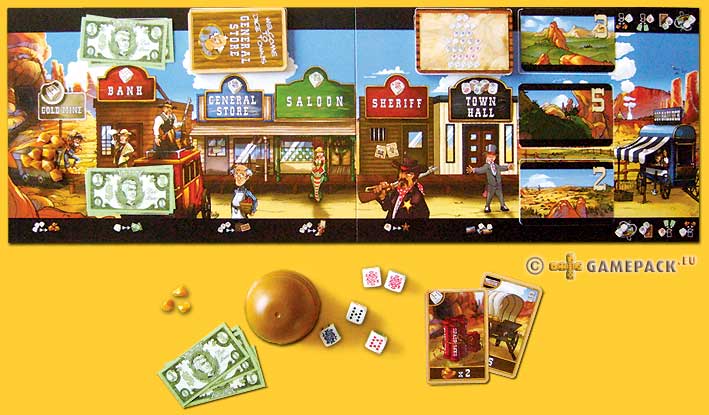
| 22.06.09 We'd better put this right away: not every dice game is fun. In 'Dice Town' players throw their poker dice and form combinations to collect cards, money or gold, each of it worth points. A lot of dice throwing is done, and each time one die - or more dice against payment - may be kept hidden under the cup, separated from the other dice; players reveal their precious simultaneously and put them aside. When a player has archived his last die, the other players may throw a last time and must keep the result of this roll and add it to their already saved dice. Players now compare their results and the player with the best roll at each location may take away the profits there. This way, a player with the most nine's gets gold, the one with the most ten's gets the money from the bank, and the player with the best poker combination may take from one to three cards at the town hall, each of them worth from one to five victory points. Annoyingly, the player with the most ladies in his company may steal a card from an other player, so why bother to achieve the best poker hand as stealing is much more convenient? The game board only is the carrier of cards, money and gold, so it merely is an excuse to pimp up a card game to a full boxed board game. The symbols at the locations that explain which poker combination earns what, are printed so small that its use as player aid would be better off on a card available to each player. We continue: the fiddling with the dice under the cup is a recipe for players wanting to cheat; at a distance it is difficult to see the combination of dice a player is working at - the placement of dice at a location as in 'Alea Iacta Est' would be a better solution; and as a last remark: the poker symbols are not everyone's child's play. Despite the clangour of dice it never was more silent during a game. By its appearance 'Dice Town' promises an atmosphere of joy and liveliness - however, in contrast each player quitely shuffles his dice. No, 'Dice Town' is more of a ghost town to us! Dice Town, Ludovic Maublanc & Bruno Cathala, Asmodee / Matagot, 2009 - 2 to 5 spelers, 8 years and up, 30 to 45 minutesxxtopxx |
 |
||||||||||||||||
| x | |||||||||||||||||
|
Finca | ||||||||||||||||
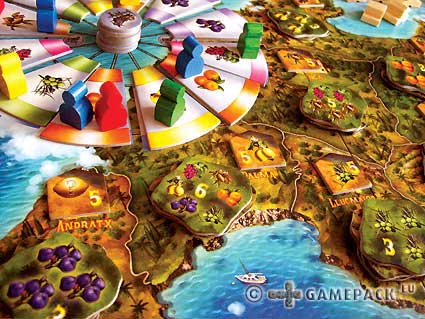
| 06.05.09 An island. Give it a name. Call it Mallorca. Divide it into regions. Make it fertile. Overflow it with harvest of all kinds. Let the players collect the harvest. Create demand. Give the players on delivery a reward in the form of points. Stone the player with the most points. Correction: honour the player with the most points. Apart from the textual corrective surgery, it all does not sound very adventurous. But to go straight to the point: Finca plays very nice and swift, and has everything in it to become the Darling of the Year. Listen: Players move their peasants on the wings of a Spanish mill - just use your imagination for once, will you? Each of the wings depicts a different kind of fruit: almonds, figs, oranges, lemons, olives or grapes. In their turn, players move one of their peasants on this wing, and harvest just as much fruit on the wing they end their turn on as there are peasants on that wing. Harvesting is that easy! Where can the goods be delivered? Well, in each of the regions of the island is a pile of fields of which the top one is open and shows what combination of fruit has to be delivered there, from one to six the same or different fruit. The points awarded are the same as the amount of fruit on a field. When a player has collected the demanded stuff, instead of moving one of his peasants, he may choose to deliver. This is done with a donkey cart - it was in the times way before the EU-grants - and this cart must be borrowed, made or built, but anyway, after each delivery we suddenly lose it and so it must be acquired again! On delivery the player gets the field tile that he place face up in front of him, and the next field tile on the board is turned face up. Each player has some special action chits that can be used, one at a time, in any one turn after which it is discarded and removed from the game. When the last field tile in a region has been taken, a last bonus chit goes to the player who has collected most of the depicted fruit on their field tiles. The game ends on a varying number of empty regions, dependent on the amount of participating players. Players then count their points from the fields and bonus chits. ‘Finca’ is easy to play, but has sufficient tactical considerations to make that makes it attractive to players of any kind. It is astonishing that a simple and, in fact, downtrodded game idea brings about such a different and nice sensation. Did we say Darling of the Year? Oops, we must take care not to cuddle it to death then! Finca, Ralf zur Linde & Wolfgang Sentker, Hans im Glück, 2009 - 2 to 4 players, 10 years and up, approx. 45 minutesxxtopxx  |
 |
||||||||||||||||
| x | |||||||||||||||||
|
Eine Frage der Ähre | ||||||||||||||||
|
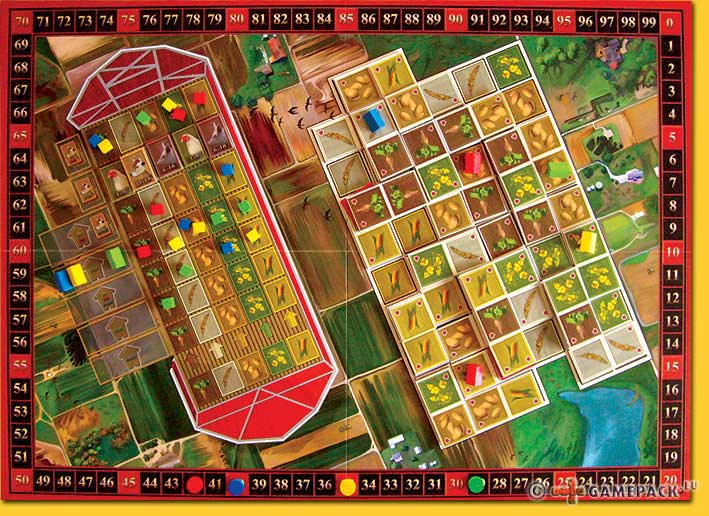
01.05.09 Examination question at the Game Academy: Give the definition of ‘Eine Frage der Ähre’. Question 2: Wow! That sounds heavy! Is ‘Eine Frage der Ähre’ a difficult game? Question 3: Who is ‘Eine Frage der Ähre’ meant for? Question 4: Is it an interactive game? Question 5: Is ‘Eine Frage der Ähre’ fun? Judgement Game Academy: candidate GRADUATED |
 |
||||||||||||||||
| x | |||||||||||||||||
|
Der Name der Rose | ||||||||||||||||
| 16.01.09 Brother William and his assistant Adson are guests in a monastery in the Alps. During their stay, several murders are committed! William and Adson decide to start an investigation. The players each take on the role of one of the suspected monks, and they try to go about their usual business without arousing any suspicion. The player that acts the least suspicious wins the game. The tricky part is that we don't know who is playing with which colour. In each turn, you play a card that allows you to move a monk - not necessarily your own monk! - to one of the buildings of the monastery. If the building contains a counter in the same colour as the monk that just entered it, the monk has a chore to do there, and his presence in that particular building is legitimate. But, if there is no counter in his colour, the monk has absolutely no business there, and he arouses suspicion. His marker advances on the suspicion-track. Subsequently, the marker on the sun clock is moved forward as many spaces as is indicated on the card that was played. When the marker on the sun clock has finished its round, the day is over. The suspicion-points of the various monks are then converted into evidence-points on the evidence-track, and a new day begins. This is repeated six times, and after the sixth day all players can make wild guesses as to what player is playing with which colour. For every correct guess, the evidence-marker advances on the track. The player whose monk aroused the least suspicion wins the game. It all revolves around keeping your identity secret. You try to make your character less suspicious without being too obvious, or you try to make your character a little bit more suspicious merely to fool the other players. You are dependent on your cards; often you can only make moves that are not really good or really bad for any of the monks. What it comes down to is that everybody is making random moves. That doesn't make it any easier to guess who is who. Additionally, the game is very repetitive. Every turn is the same, every day is the same, there is no development in the game. And what silly reasoning is it anyway to assume that the monk that aroused the least suspicion is also innocent?? It certainly wouldn't hold in court. Both the book ànd the film follow a more convincing plot. Barbara van Vugt Der Name der Rose, Stefan Feld, Ravensburger, 2008 - 2 to 5 players, 10 years and up, no time indication (appr. 75 minutes)xxtopxx |
|
||||||||||||||||
| x | |||||||||||||||||
|
Deukalion | ||||||||||||||||
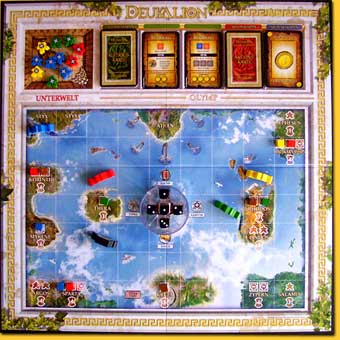
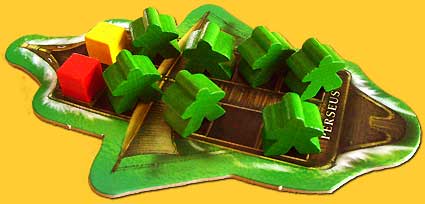
| 02.04.08 Deukalion was the son of Zeus, who, just like Noah, was ordered to build a ship because of an imminent flood that also in this case fully was avoidable, but sometimes these gods fancy some disasters they send to us. Nice, though, that they warn us timely, just like an anonymous bomb layer: '...in this so and so street, at eleven o'clock. A black sporting bag. No, a bit further, turn right at the traffic lights and then past MacDonalds. Yes, that's it. Eleven o'clock it goes off, you got that? So if you just take away that bag before eleven, nothing's going to happen. Cool, thanks!' Now we got this boat, we just as well might sail away to relive Greek myths. No knowledge of these is required, as it merely comes down to a lot of fighting and fulfilling various assignments. These assignments come from a stack of cards, two of them are always visible until accomplished after which they go as victory points to a player. Fulfilling tasks is a mere acquiring of coloured cubes scattered over the various islands, and bringing them to Athens, where players at game start start their journey. After a by the amount of players preset amount of victory points, the game ends. The presence of dice, started in players season '07, has been maintained in the spring collection of '08; we even could talk of a renewed trend. With these dice various known things are handled such as movement and fights. New is that this is done in a special cup (the 'kylix'), and that a player by the way the dice are placed in this cup has a choice of how to use them. The fights are done by the crew on our boat that somehow resembles a space ship. We throw the men on the table; all that fall flat on their face are worth a full point, those who show a cross are apparently dead and go to the corner (Styx) as a form of punishment. All men on their sides are worth a half point. The defender also throws his men, and the player with the most points has won the fight and may take a cube off the opposing ship or take an action card from the opposing players hand. These action cards show texts such as a reroll in a fight, or taking one or more men from the Styx and place them back on your ship. Cities also can be attacked to get the cubes that lie next to them; a city shows a value that at least must be equalled in a throw with the crew of the ship. Some cities show one or two men; when leaving this amount of men on the city as a kind of garrison they are worth one or two points, but other players could attack the city and place their own men in a future turn. 'Deukalion' really looks good, and has some nice elements of which the 'kylix' is a nice gimmick. The movement of the ships is limited to the area around Athens as it is not worthwile to go beyond and visit a distant island. At the end we are left with an unsatisfying feeling; 'Deukalion' indeed seems to come from Antiquity, but this time in a game technical way: from the end of the seventies, beginning of the eighties; as a game of 'Deukalion' can be quite unbalanced. For instance: a fight is lost, and the opponent may put the ship three squares back, way out of all action, so it takes a player a turn or two to get back. Also he looses a cube or an action card, ok, but his 'dice', his fighting power is minimised as the lost men in the fight are put in the underworld (Styx) and cannot be used in future rolls. Only if a player passes a full turn he may take two men back on his ship. This way a player who lies ahead is difficult to catch up and this qualifies the game in the false warm-hearted category 'Nice to have had you here, but unfortunately we have to say goodbye already'. 'Deukalion', it was nice to have it played, but it did not have much volume of displacement. Deukalion, Arno Steinwender & Wilfried Lepuschitz, Hasbro, 2008 - 2 to4 players, 10 years and up, no time indication (about 60 minutes)xxtop |
x |
|
|||||||||||||||
| x | |||||||||||||||||
|
Fragile | ||||||||||||||||
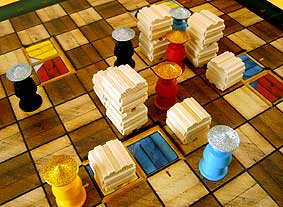
| 30.06.07 Careful! Watch it! Fetch that crate! No, this way! It is rush hour at the wharf of Shanghai as the goods have just been unloaded and have to find their way to the warehouses. But it is just like food relief: on a first-come-first-served basis, so all Chinese trip and hinder each other to get hold of the crates and secure them in one of their warehouses. Up to five action points may be used on one playing figure: walk, push, stack or pass on. This last action in particular makes that the game becomes an inventive puzzle game, as with passing on the adjacent playing figures of other players can be used to pass a crate on several squares, even into a players own warehouse. When a player has placed a crate in his last warehouse, the game ends, scoring one point per crate with an additional point when the crate has been turned onto its 'fragile' side. This is only allowed for crates that are not yet stored in warehouses, and this action may not be combined with placing the crate into a warehouse in the same turn, which makes it a tricky operation. So, if you would be so kind to turn the crate over in your turn, then I could take it from you and move it into my warehouse! The game is beautifully produced and this is what it really makes standing out: nice playing figures with hats painted with glitter paint and tiny crates of real wood. The game box itself is of wood too, and to finish it the components are packed in wood-wool. All of it completely unnecessary, but hey, who does not want something nice to look at? Thanks to this superb execution, people who like to show their set of chess pieces now are given an alternative! Fragile, Czarné, Ludo Art, 2006 - 1 to 4 players, 10 years and up, 30 to 45 minutesxxtop |
 |
||||||||||||||||
| x | |||||||||||||||||
|
Der Markt von Alturien | ||||||||||||||||
| 11.05.07 To clarify right away: this is a light weigth family game with a short playing time, perfectly suitable for the occasional player who does not like all too complex games. The game makes use of familiar mechanisms, and even a comparison with Monopoly would not be unbecoming. First the players may divide six customers over the board, and place four of their trading houses after that. With the roll of a die one of the customers may be moved according to its facing; on crossroads the facing must be turned towards the new direction. If the customer lands on a square with a trading house of the players colour he gets paid: two per house, multiplied by the importance of the customer - from one to three, with a bonus for a majority of trading houses in a coloured quarter. Dark grey squares with trading houses get paid also if there is a customer of any kind on it, even if it was not the actually moved customer; this way more than one customer may bring in money for a trading house. The money is needed for the purchase of further trading houses and cost from two to five money, but in order to win the game prestige cards will have to be purchased at some time, as three of them end the game. Meanwhile there also wanders a thief around the board, who is brought into the game when at one time the current player has more than 10 money - bought prestige cards counting also as money. The thief may be moved by an extra die roll to steal money from the other players. The unfortunate player is guarded against a further theft by the city guard (card), unless he is the wealthiest player at that time; in that case the card goes to the poorest player. The game features a small extension in which special cards can be bought, bringing the owner additional money, or give him the use of a second die in order to have more choice when moving one of the customers. This does not make the game any more complex; the basic game even could be played by kids as young as 8 years. The over dimensioned sedate game board is a nice contrast with the fluorescent colours of the trading houses that somewhat look like a spirit stove; the very moody cover illustration would become well in a fairytale book; the decorating frame elements give it a sort of fin-de-siècle feeling. The game box itself is oversized; this could have gotten a more compact size, for us players who will have to find the storage space for it, as well as the stores who will have to deal with the same shelf problem. 'Der Markt von Alturien' provides a little under an hour playing fun where the decisions to make are very transparent, and where each player gets his share: ...three, four; now I'll first move the thief at your house, yes: paying time! Der Markt von Alturien, Wolfgang Kramer, Pro Ludo, 2007 - 2 to 6 players, 10 years and up, 60 minutesxxtop |
|
||||||||||||||||
| x | |||||||||||||||||
|
Fiji | ||||||||||||||||
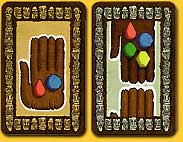
| 21.02.07 In ‘Fiji’ two to five players are going to collect shrunken heads; the favorite pastime of the author must have something to do with the shady side of life - it changed his hair into green, that’s for sure! We have to collect these heads to sell them to museums; ah, culture, no problem! The islanders on their part are keen on beads, and trading the two makes us owner of the desired goods. This takes two rounds; first a column of four cards is laid out, each consisting of a row of one demand card and one payout card. After three phases of trading the players match their beads against a row of four goal cards (most/least of a kind), of which only the first is important; the other three are only needed in case of a tie. The player who matches this condition, gets one shrunken head less than the amount of players. This whole sequence is repeated four rounds, after which the player with the most shrunken heads has won. There are four different colours of beads that each round are dealt in a fixed combination; beads from each former round are returned to the pool. The remaining beads form the stock. In each trading phase the players take 1 to 4 beads of any colour into their hand, after which the condition cards are worked one by one. The first condition always has to do with having the most or least of a certain colour; the second card shows what a player may take from the stock. When more than one player qualifies, or not enough beads are in the pool, the trade is cancelled. There are cards that give one bead of a colour to each player except the one who met the condition, or that a goal card has to be changed, ruining all planning so far. All this juggling and bidding in consecutive phases gives the game a rather dry and artificial feel; in the bidding style we have seen better games. Repeating the same sequence for a number of times is a weakness; it does not increase the tension but merely is more of the same. Finally, the brown tints and rough illustrations do not contribute to the exotic atmosphere that is suggested in the blurb text on the back of the box. No recommendation. Fiji, Friedemann Friese, Rio Grande Games, 2006 - 2 to 5 players, 10 years and up, 30 minutesxxtop |
  |
||||||||||||||||
| x | |||||||||||||||||
|
Die Baumeister von Arkadia | ||||||||||||||||
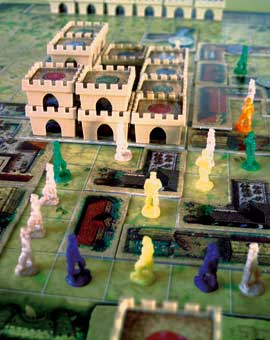
| 26.11.06 Pick up your cement tub, because it's building time once again! This time our journey leads us to Arkadia, with its gentle slopes and fertile valleys. It is here that a city must be erected, with a massive castle as its central master piece. At the same time this palace triggers the payment of the surrounding buildings, and the player that has gathered most of it by game end wins. At the start of the game each player is dealt four building cards, on which buildings of varying size and colour are depicted, one on each card. They also get three workers in their player colour that they put behind their player screen. In a turn, a player decides wether to play a card or to place one or more workers adjacent to any single building. When playing a card, he places the building tile onto the board adjacent to any other tile or the castle building ground, and he puts a seal on it that matches the colour of the played card. It doesn't get tougher than this. When a building is completely surrounded by other buildings and/or workers, it gets scored and every player that has a worker in his colour next to it, gets a seal in the same colour of that on the building. The player that triggered the scoring gets the seal on the building as a bonus. After this he has to place a palace piece; during the first phase of the game he is only allowed build at level one high, during the second he builds on the second level, and in the last phase each player may only build one final palace piece on the third level. There are only so much pieces per phase in the stock, and from each of the first two phases two pieces remain that get transferred to the stock of the last phase. Each palace piece has a coloured seal showing on the roof. When a player takes an extra action and hands in one of the four streamers that he got at game start, he gets two additional workers. Apart from this, he may cash for the collected seals against the daily rate: the number of seals visible on the roofs of the castle, multiplied by the collected seals of that colour. The scarce workers can be added with a neutral one that may be taken for each preprinted tent that gets covered when placing a building tile. It may not seem much, but this way it helps to handle the scarce resources that laborers are. It might even be better to surround a building with another building, just to save workers. The scoring might be less, but at least the player still has ammunition to score at an addtional spot. When one player has collected many seals of one colour, other players surely will cover that palace seal and place one of an other colour more favorable to them. When the second level of the palace is completed, each player has one final turn in which he could place a thrid level palace piece. Everything in this game looks just fantastic! The atmosphere is great, choices are simple with the neccessary tactics, it plays swift, and tastes for more. Ravensburger has made a great game for us (spoiled) gamers once again. And you know what: it feels Chinese Dam good! Die Baumeister von Arkadia, Rüdiger Dorn, Ravensburger, 2006 - 2 to 4 players, 10 years and up, 45 to 60 minutesxxtop |
 |
||||||||||||||||
| x | |||||||||||||||||
|
Der Dieb von Bagdad | ||||||||||||||||
| 16.11.06 When someone has acquired a bit too much wealth, there are others who are more than willing to balance this unasked. Of course there are enough candidates to perform this noble task; take Ali and his comrades for instance, all from a well respected thieves guild. For them this is daily and hard labour: try to avoid the guards and slip into the palace unseen, climb against the walls of one of the six palaces in Bagdad, and set the owner of the treasure chest free from his sorrow with the help of our nephews, cousins and other relatives, all dependent on the measurements of the chest. This could be mistaken for plundering or theft, but in fact it is macro financial management combined with a short term demand on the goods market; the thieves guild in Bagdad has its own oriental and peculiar view on the world too. Dependent on the amount of players a preset amount of chests has to be secured; as it is called in the local jargon. At the start of play neutral guards are placed at each of the six palaces; thereafter the players place their own coloured guards that they already bribed as these are a prerequisite for a thief to enter a palace. In a turn, unlimited cards may be played that each have a colour of one of the palaces; these cards move a guard or a thief. To get a thief to enter a palace, the number of foreign guards, including the ones of other players, are counted, and this is the number of cards that must be played for one thief. As a consequence of this, guards are moved back and forth, until enough thieves have entered the palace and a chest can be lifted; the thieves involved go back to the players stock. Now there is a new chest in the palace that needs one more thief in order to claim it. Of course each player lacks the right cards, or sufficient cards, or gets hindered by a player who puts his or a neutral guard in a palace where he just wanted to build 'cheap', for only one card per thief. Three cards are drawn at the end of a turn; if a player forfeits any action he may take four, one of which is a wild card. 'Der Dieb von Bagdad' is an uncomplicated swift game with no hurdles that takes less than an hour and will attract players of any kind. Der Dieb von Bagdad / Thieves of Bagdad, Thorsten Gimmler, Queen Games / Rio Grande Games, 2006 - 2 to 4 players, 8 years and up, 60 minutesxxtop |
 |
||||||||||||||||
| x | |||||||||||||||||
|
Die Säulen von Venedig | ||||||||||||||||
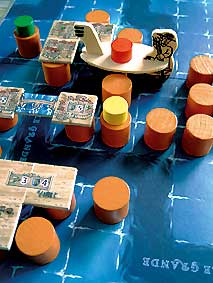
| 20.10.06 Our help is wanted in Venice! The only thing we have to do is aiding in surrecting the city, and get fame and honour in return! Oh well, points, OK, it's just the same to me! The first thing to be done is constructing the base with tarred pillars, in the game for more convenient purposes varnished wooden discs. Smaller coloured player discs are subsequently strategically put on top on some of them, and earn points when other players build over these positions. These and other actions are simultaneously chosen from a player hand of five cards, one at a time, carried out in turn order. The played card then is passed to the left hand player, enabling him to use that card in a later round. The spy character for instance lets a player look in another players hand, take one card from it and play that card immediately. The spy in turn goes to the robbed player. The gondoliere enables a player to put his player disc on the plywood gondola, giving him points for each city part that is built by any player next to the Canale Grande. Each player starts with a minimal amount of city parts; further parts must be taken from the general supply by playing the counsellor card that comes in various values allowing smaller or larger city parts to be taken. Players are awarded points by building city parts, placing them on top of the pillars. Larger parts earn more points, and bonuses are awarded for matching adjoining city parts. Play ends immediately when the stock of pillars is depleted, the round is not completed. 'Die Säulen von Venedig' is a lively and nice looking game with a nice atmosphere; not complex but still challenging, and because of this suitable for each kind of player group. Because of all these characteristics, and just to start an early speculation: this game might be a candidate for a nomination for the Spiel des Jahres! Die Säulen von Venedig, Christian Fiore & Knut Happel, Goldsieber Spiele, 2006 - 2 to 6 players, 10 years and up, 45 to 60 minutesxxtop |
 |
||||||||||||||||
| x | |||||||||||||||||
|
Die Säulen der Erde | ||||||||||||||||
| 07.10.06 Two to four people participate in building a cathedral. At game start, each player gets three laborers: a mortar mixer, a carpenter, and a mason. These laborers are used to turn the collected resources in a round (sand, stone and wood) into victory points, necessary to win the game. Resources may be collected by picking one or more worker cards from a open set of seven cards; two other cards are new laborers that can be bought from the initial 20 gold. A player may have a maximum of five laborers working for him. The worker cards show a number in one of the three resources that can be claimed with a varying number of small wooden worker tokens; each player can assign all 12 of these every round and place them at the appropriate quarry or in the woods. Left overs, when not enough workers are left to 'buy' a worker card, are placed at the wool manufactory. After this, the starting player draws one builder token at a time from a cloth bag; each player has three of these in his players colour. The first player drawn must pay 7 gold to place his builder on one of 14 locations on the board, or pass and leave his token momentarily on the '7' spot. The second player pays 6 or must pass, etc., untill all paying players have placed their builders on the board or have passed. After this, all passing players may place their left over builders, one by one, for free. Then, in chronological order, all actions on the 14 locations on the board are carried out. First, an event card is read out loud that affects all players, except the one player that has placed his builder at this location. The resources now may be collected, and the players get their workers back for a following round. Taxes must be paid too, and the players that did not place a token at the King's location, must pay from 2 to 5 gold, decided by the roll of a die. There are locations where privilege cards can be taken, some of them have an immediate effect, others may be saved for a future round or occasion. At the village are two labour cards; one for each player that has placed his builder there. At the market additional resources may be bought or sold, and finally, the starting player ends the round by placing one of the six wooden parts that form the cathedral. After six rounds the game ends. Players constantly move between decisions like pumping up their gold, or converting the resource cubes into victory points, and this is what the game makes fun. Adding certainly to the atmosphere of the game are the beautifully illustrations by Michael Menzel; the mapboard is full of detail. The labour cards could be seen as an example of a romantic Soviet view of the labor classes, but this is not meant to be critical at all, the illustrations are simply very well done! There is much more in the game that has not been said; we keep that for a full review. But what kind of game is it? The 'collecting scarce resources and trading them in for something more valuable-game' resembles many other games. But because of this familiarity players instantly feel comfortable when playing the game, no matter if it resembles 'Game X-Light' or 'Game-Y Medium'. The parts of the cathedral are only used to mark the starting player of a round, they serve no other function. But again this is not to be taken negative, would it have been left out, it would have felt somewhat strange for a game on cathedral building. And it feels good to see a publisher who puts superfluous material in a box! Two players are done within 90 minutes; four players need some twenty minutes more. After that, we are left with the feeling that we have experienced a very good game, maybe even one of the highlights of this year. Die Säulen der Erde, Michael Rieneck & Stefan Stadler, Kosmos, 2006 - 2 to 4 players, 12 years and up, 90 - 120 minutesxxtop |
|
||||||||||||||||
| x | |||||||||||||||||
|
Extrablatt | ||||||||||||||||
| 12.08.06 It is difficult to describe why one game is more appealing than the other. Sometimes you just feel comfortable at it, and does it serve to your taste. I like the idea of putting together a newspaper, 'pasting' the various articles that you take from the 'telex machine' - a window of small news item cards. How large will I bring this item? Only the largest ones will be scored at games end, so you must bring the same item larger than your opponent, if they already have one in their paper. Each news item has three fax chips, and is subject to larger categories such as politics, religion, various, etc. So apart from the one item that lies open on the fax sheet, it may or may not be the only one that becomes available during the game. Bonuses are awarded for the player who has the largest category (several different articles -but of the same category- one or the other way adjacent to each other), and you get double scores for an article in the head lines section. If you have come out with an article, and an other player brings the same item larger than yours, there is always the possibility of putting a canard chip on his article, making it worthless. These chips occasionally come from the telex in the form of socalled time motors; each time when a column of the telex has to be replenished and such a chip gets drawn form the stock, the clock is adjusted one hour forwards (the game lastst 12 game hours but the time motor chips make it unpredictable how long in real time it will last). When a player chooses to take such a time motor chip from the telex, instead of the 'normal' move of taking a news item from it, he can use it to put it as a canard on the article of an other player IF he has the highest value of one cheque that gets exchanged between these two players: at games start, all players got dealt a set of four cheques, with varying and all different values from 1000 to 12000. When two cheques get exchanged, the highest values wins, with the exception of the 1000 beating the 12000 cheque. The player who played the highest value, may now perform the action - and this could as well be the 'defender'! There are three 'flags': at 4 o'clock, at 7 o'clock, and at games end (12 o'clock). Whenever a time motor advances the clock and crosses a flag, all articles already laid out on the paper are labelled; with a '10' at 4 o'clock, a '20' at 7, and '30' at 12 o'clock. These are the possible scores for the articles (but remember, only the largest ones get scored at games end). So basically you try to fill your news paper in the most efficient way, trying to beat the competition with a larger article or a canard. 'Extrablatt' is a nice game - it is what the title says: you are busy trying to put a paper together, and every element of it fits nicely. This game deserves to be reproduced, as it is not overly complex and certainly will appeal to a larger audience. Extrablatt, Karl-Heinz Schmiel, Moskito Spiele, 1991 - 2 to 4 players, 14 years and up, 120 minutesxxtop |
 |
||||||||||||||||
| x | |||||||||||||||||
|
Emira | ||||||||||||||||
| 26.07.06 Some men will have to get accustomed to it: looking with somewhat more attention in the mirror, and act accordingly: are the split ends of the mustache removed, the richly grown eyebrow hairs trimmed, and the shining skin powdered at places? Are the fresh and ironed clothes neatly tucked? Did we put the flowers in the back of the camel, and regarding good manners: did we make sure our middle finger is where it belongs - in rest position, next to the four other fingers? Then we are ready to go on audience with the women. In 'Emira' three to five players try to get the favor of the women, and invite them in their harem. The game is won by the player who manages to get a by the amount of participating players preset amount of women in his harem. At the start of play players are dealt a conditons card. On this card are the special capabilities of the women he needs to look for in order to get a sort of discount in the amount of collected women. If he fails to fulfill this condition, he must collect the full amount, which is equal for all players. The women are represented by cards which enter the game one by one, with the occasional exception triggered by an event card. On the card is the preference of the woman depicted, because she chooses the player which matches her personal taste the most. She looks for beauty, good manners and clothes, but housing and status also can be decisive. Of course all these matters cost money, not in the least because players have to bid to get the right to buy an item from the window - they do not just get it! Only after a player has won the bidding, he decides which action he will perform and marks it with his player disc - this action may not be chosen anymore this round. Each round players get a base income, but it is the same old story in the land of One Thousand And One Nights as it is here in the modern world: the welfare state has deteriorated, and we will have to replenish our income with private herb fields (and no, they are not weed fields!) that will have to be bought in an auction too. Most women bring the harem to life with their personal capabilities: some outright steal from our stock, others bring their own gold so we don't need to pay her any money, another lady brings a discount when building a new wing to our palace. The sheiks have their preferences too and do not want just everyone in their harem, but they have no voice in this: if one meets the criteria, the lady joins his harem. Take Xenia, for example. When she comes to sit on the comfortable cushions of your harem, on every third round she demands pocket money, being 250 gold; and this includes the turn she enters the harem. All the other ladies only need to be supplied with 50 gold per round. Xenia's preference is money, this is clear, and obviously she will pick the richest sheik. This leads to the hilarious situation that when Xenia is out on the table, all sheiks buy whatever they can, bidding enormous amounts, just to not be the richest one to be left with this demanding lady! Buying camels give a discount in the bidding phase, and this can further increase if one or more event cards regarding the camels are played. The graphics by Franz Vohwinkel are beautifully done; he must have been working at it with much joy, and it shows! 'Emira' basically is an auction game with some development; in this regard it reminds a bit of 'Goa', but the players interaction in 'Emira' is definitely higher! 'Emira' is a very joyful game, albeit a bit on the long side. The 75'plus' minutes according to the box are a large 'plus': our first play with five players took more than two hours. Even with experienced players this game probably will take more than 90 minutes. Be it so, 'Emira' is one of the nicest games published this year, although less suitable for those who don't like (longer) auction games. Emira, Liesbeth Vanzeir & Paul Van Hove, Phalanx Games, 2006 - 3 to 5 players, 12 years and up, 75+ minutesxxtop |
|
||||||||||||||||
| x | |||||||||||||||||
| x | |||||||||||||||||
 |
|||||||||||||||||
 |
|||||||||||||||||
 |
|||||||||||||||||
| x | |||||||||||||||||
 |
|||||||||||||||||
 |
|||||||||||||||||