| x | ||||||||||||||||
 |
Orongo | |||||||||||||||
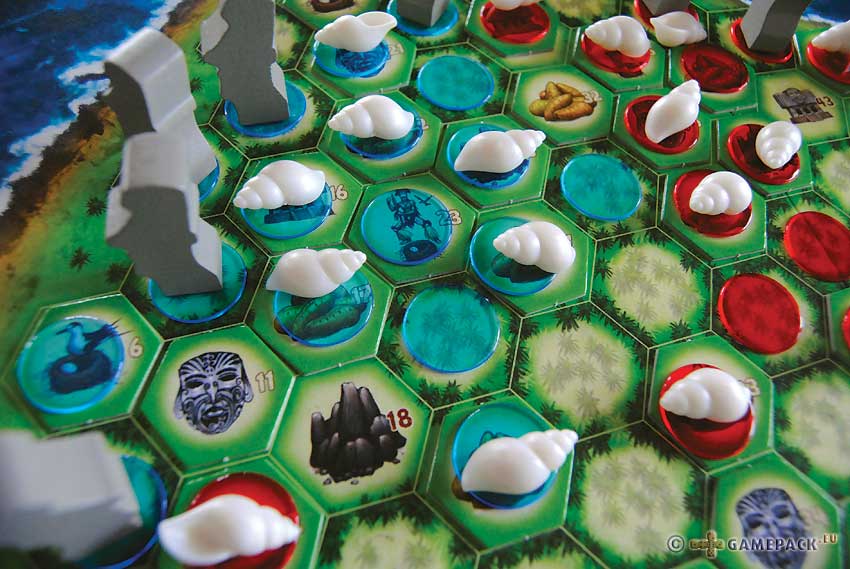
| 22.09.15 How the inhabitants of Easter Island managed to erect those immensely heavy statues, the Moai, along the cost is still a mystery. Many theories have been formed on the topic, but no convincing evidence has been presented yet. In Orongo, it doesn’t matter how we do it, as long as we do it fast! The first player to erect all his Moai wins the game! The board depicts Easter Island, with a grid of hexagons. There are seven different illustrations depicted on the hexes. The aim is to connect specific symbols, by forming a route of transparent tokens in the player’s colours. As soon as a connection has been made, a Moai may be erected along the coast as a reward. For example, a birdman has to be connected to a nest, et cetera. Despite the fact that these symbols are printed on the board, they are not really there yet. Only after the corresponding (numbered) tile has been drawn and placed on the board, the location becomes ‘active’. Depending on the number of players, 3 or 4 new tiles are drawn each round. The players bid with shells in order to place their tokens. Everybody reveals their bid simultaneously. The highest bidder pays his shells, and places three tokens on the board. The second-highest bidder may keep his shells, and place two tokens. All other players also keep their shells, and place one token. Only the players with a bid of 0 shells are not allowed to place a token. But, they receive all the shells from the supply! And this supply consists of the shells paid by the highest bidder of the current round, but also of previous rounds! Tokens are placed only on ‘active’ numbered fields, or on a palm tree field adjacent to any field occupied by one of your tokens. As soon as you have managed to connect two symbols that belong together, you immediately place one of your Moai on a coastal palm field within the same group of tokens. Additionally, the two symbols are covered with two of your shells. These shells stay there for the remainder of the game! To begin with some criticism: it is difficult to see which numbered fields are ‘active’ (covered with a tile) and which are not (even in the improved version of the game!). And the colour of the transparent tokens is also difficult to distinguish once on the board. Especially blue and green look very similar on the greenish map. Sometimes this is annoying, but it’s not an insurmountable problem, though. Of course you also have the element of chance to deal with; you never know when the tiles enter the game and the corresponding fields become active. For example, it is very well possible that you claim a birdman in your first move, but that the corresponding nest is drawn only at the end of the game.. and of course by that time the route will be claimed by another player. Blocking other player’s routes is one of the nicer elements of the game; in the landscape of games where all players are solitarily trying to develop something on their own player board it’s rather refreshing to encounter a game where the players continuously block and annoy each other! The bidding mechanism also works very well: sometimes you want to go first because you want to place as many tokens as possible, and sometimes you just want to be the first to claim something before anyone else does. Because only the winner has to pay his bid, you don’t want to grossly overbid too often. It’s therefore crucial to estimate what your opponents are planning to do and how much it’s worth to them. All in all a refreshing and smooth game! Barbara van Vugt Orongo, Reiner Knizia, Ravensburger, 2014 - 2 to 4 players, 10 years and up, 30-45 minutesxxtop  |
 |
|||||||||||||||
| x | ||||||||||||||||
|
Norderwind | 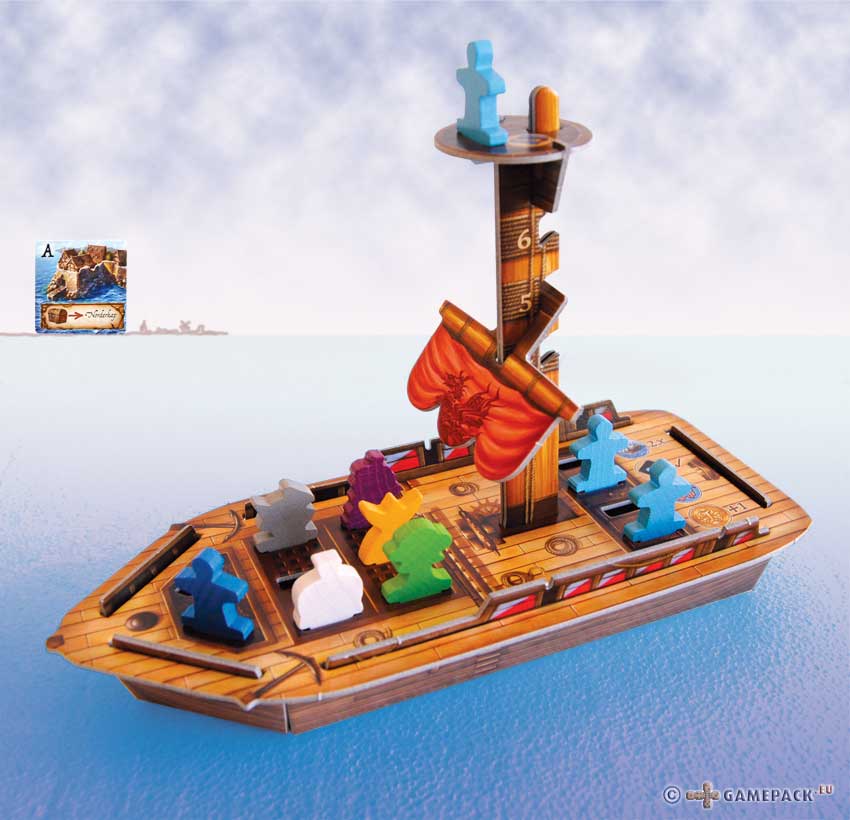  |
||||||||||||||
| 27.09.14 The harbours of Norderkap, Trutzhavn and Olesand are under frequent attack of pirates! The players are sea captains with the double task to firstly provide these cities with the necessary goods, and secondly to protect them from pirate attacks by attacking pirates themselves. Each player has a real 3D ship with room for several goods, with a prison for pirate captains, with room for no less than four cannons and four crew members, and an adjustable sail! The gameplay is identical to the Catan-cardgame Sternenfahrer by the same author. In his turn, a player selects one of three stacks of cards (coupled to the three harbours). The player reveals the cards one by one, and decides for each card whether or not he wants to carry out the depicted action. The position of his sail determines how many cards he may sail through (4 to 6), but irrespective of this number, he may carry out only two actions per turn! After his trip the cards are shuffled again, so there’s no need to memorise the order of the cards. The actions include buying or selling goods at a set price, upgrading your ship (purchasing cannons or crewmembers, adjusting your sail position) and fighting pirates. The most important action is the action associated with the harbour: deliver the demanded goods, coins, or pirate captains and place a cube in your colour on the board. The first player to place all his (8-10) cubes wins the game. As mentioned before, Norderwind is strongly reminiscent of Sternenfahrer. Here, you also travel in decks of cards, and increase your chances of success by upgrading your (space)ship. But Norderwind is definitely a simplified family-version. There is not much to it: in no-time everybody knows in which stacks which goods can be bought for little and/or sold for a lot. With the money you make you can upgrade your ship, which gives you additional options and a better chance to beat pirate ships. Each stack always consists of 8 cards: no cards are ever removed or added to the stacks. With your sail in the maximum position you can travel 6 cards; with a crew member in the crow’s nest you can look at an additional card. So, if you are looking for a specific card, for example the harbour-card, you are almost certain to reach it within your turn. The game even has interaction: when the active player chooses and carries out an action, the other players are also allowed to perform this same action if they are willing to pay a letter of credit. These letters of credit can be obtained when a player in his turn performs only one or no action instead of the allowed two. Because it is basically a remake of Sternenfahrer, Norderwind can’t possibly qualify as ‘original’; although the name ‘Catan’ is nowhere present in the rules, the game is clearly Teuber-offspring. But, as a family game, there is not much to criticise: the rules are simple, the design is very attractive, gameplay is supple and it’s not too lengthy. In this lightweight category, Norderwind easily passes the scrutiny. Barbara van Vugt Norderwind, Klaus Teuber, Kosmos 2014 - 2 to 4 players, 10 years and up, 60 minutesxxtop |
||||||||||||||||
| x | ||||||||||||||||
 |
OddVille | |||||||||||||||
|
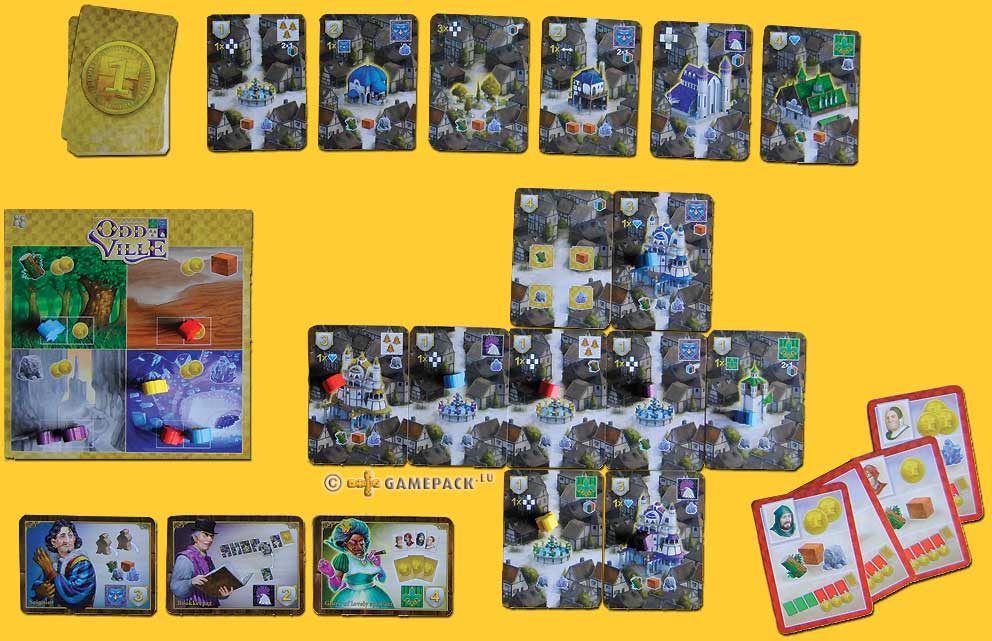
20.05.13 Four powerful guilds have entrusted us with the task to build a city. There are no blueprints available: the city will go by the name 'OddVille', so it's no problem at all if it turns out to be a chaotic mixture of architectural styles. The player with the best contribution wins the game. |
 |
|||||||||||||||
| x | ||||||||||||||||
|
Notre Dame | |||||||||||||||
|
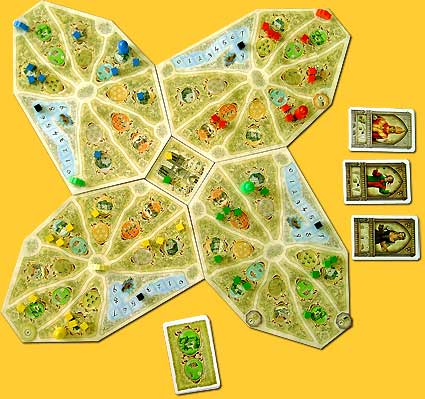
29.03.07 What about the rats? A not very common, but in ‘Notre Dame’ not unusual question, as our acting is severely determined by it. The health of our quarters are at stake, but it is more that the rats are a spin-off off the masses of people that perform all sorts of little tasks within the city walls such as driving around in little carriages, searching for victory points, bringing the children to scholl or have treatment in the hospital. Who shows up in the park, or equips the sanatorium well, can be reassured of good health and does not have to fear illness that our little nightly friends spread out. The ones who exceeds the Paris Rat Standard, have to hand in two victory points at the end of each round, as well as an influence cube, it does not come any more realistic. |
 |
|||||||||||||||
| x | ||||||||||||||||
|
On The Underground | |||||||||||||||
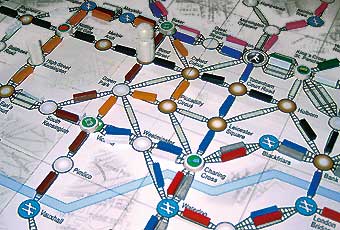
| 21.10.06 O no, not yet another route game! Nevertheless this is exactly what we have here. In the wake of the success of 'Ticket To Ride' and its German nephew 'Thurn und Taxis' it is the London Underground that serves as platform for this route building game. Technically everything goes along the same lines: laying track and scoring points. The assignment cards have been replaced by destination cards from which four are laid open. A general token travels each player turn to the nearest gold coloured location, preferably not on foot and with as little changes on the underground line. Whenever this destination is reached, another location is picked from up to four blank locations, under the prerequisite that these colored destinations are available among the four cards, that are resupplied to four after each player turn in which or two destinations have been reached. The travelled route scores points: one point for each continuous chain of track of each player that the token has used in reaching the destination. In a turn a player may build up to four track in one of his player colours; dependent on the amount of players he has two, three or four colours available to him. Once started with a colour, all track of the same colour must be connected to this track. Bonuses may be earned by reaching terminals, important junctions, or the joining of two similar symbols. Twines may be used but these must first be earned in other actions. When the card pile is depleted and all locations have been visited, the game ends and the player with the most points has won. 'On The Underground' has more than one resemblance with 'Ticket To Ride', Clippers' and 'Santa Fé Rails', all by Alan Moon, that this almost makes it plagiarism. It must be said, however, that with the series of route games that Alan Moon published he has copied himself numerous times. 'On The Underground' plays somewhat more grinding in a way, as there is more finding out how the token will travel within the system of the underground. It is not that inventing and publishing games of this type solely is the territory of Alan Moon; it's just that enough of these games already have been published. Despite the fact that this game is quite enjoyable to play, we expect smaller publishers to be more inventive in the kind of games they publish, making a difference from the larger publishers. Instead we are treated with the same middle of the road game we have seen many times before. Reasons enough to nominate this game for a 'Toodle-A-Dokey' award! On The Underground, Sebastian Bleasdale, Rio Grande Games / JKLM Games, 2006 - 2 to 5 players, 7 years and up, 75 minutesxxtop |
|
|||||||||||||||
| x | ||||||||||||||||
| x | ||||||||||||||||
 |
||||||||||||||||
 |
||||||||||||||||
 |
||||||||||||||||
| x | ||||||||||||||||
 |
||||||||||||||||
 |
||||||||||||||||