| x | |||||||||||||||||||||||||||||||||||||||||
 |
Hospital Rush | ||||||||||||||||||||||||||||||||||||||||
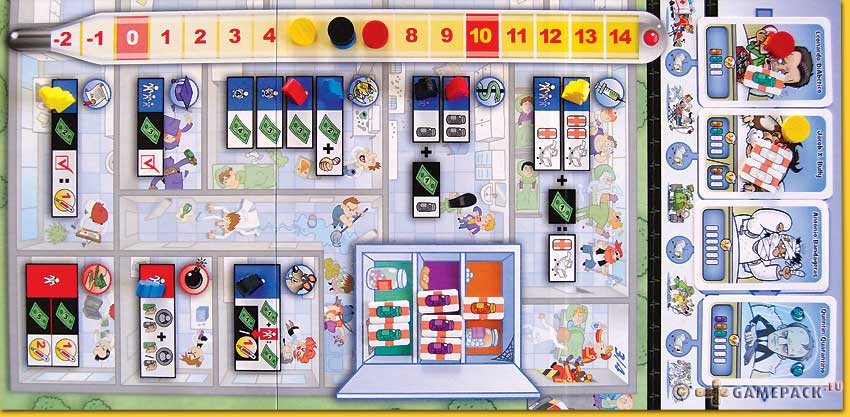
| 16.03.15 Judging by TV series one would think that all hospitals are populated with crippled, drug-addicted doctors and psychopathic janitors. Hospital Rush doesn’t paint a much prettier picture: the players are interns who are all after the same promotion and are perfectly willing to resort to underhanded tactics to outdo each other, even at the expense of the patients! The players choose one of the diverse characters and get one lousy buck as their starting cash, the beds are filled with patients (with hilarious names referring to both illness and a celebrity, such as Quentin Quarantino or Malaria Croft), the medicine cabinet is filled and we are good to go! From the starting player onwards everyone chooses an action and performs it, and then everyone gets a second action. The main action is treating a patient. Each patient requires a certain amount of band-aids and/or medicine to be cured, and by treating a patient a player can place these on the patient. A player can only treat his own patient or a patient who hasn’t been claimed yet (in which case he claims the patient immediately). Band-aids are always available, medicine needs to be taken from the medicine cabinet first with a separate action. Money rules, also in the hospital: by spending money players can give additional treatment to their patients, buy more medicine or study, which enhances some future actions. By running a couple of night shifts the players can replenish their supply of cash. But sometimes a bit more sneakiness is called for, so there are also actions like sabotage (steal money or medicine from other players) and bribery (directly buy prestige points for cash). In addition every player has two personal dastardly actions available: for example the doctor’s pet can prematurely discharge an opponent’s patient, or the scumbag can sell off medicine for some extra cash. However! All these villainous acts do carry a risk, as it is also possible to tattle to the management. This brings in extra cash for the player ratting out, and every other player (there is obviously no need to mention our own dark deeds) has to pay money or prestige for every dastardly action he has taken this turn. At the end of the round we check which patients are cured: these are discharged and the player treating them gets a number of prestige points, with the more difficult cases also yielding more points. This hospital also has a shortage of beds, so the patient that has been in the longest is also discharged, regardless if he’s cured. If someone has reached 10 prestige points the game ends, otherwise we start a new round. Hospital Rush is not a revolutionary game: a somewhat experienced gamer can easily name a dozen games using the worker placement mechanic. But because of the large array of ‘mean’ actions and the ability to tattle about those, Hospital Rush has quite a bit more venom than the average worker placement game. It’s also considerably shorter: the game can generally be wrapped up within 45 minutes. Because of these factors it can differentiate itself enough from the competition to earn a space on the gaming shelf. Ugur Donmez Hospital Rush, Thomas Kjølby Laursen, Kåre Storgaard & Steen Thomsen, Pegasus Spiele, 2014 - 3 to 5 players, 10 years and up, 50 minutesxxtop |
 |
||||||||||||||||||||||||||||||||||||||||
| x |
|
||||||||||||||||||||||||||||||||||||||||
 |
Händler der Karibik / Port Royal | ||||||||||||||||||||||||||||||||||||||||
|
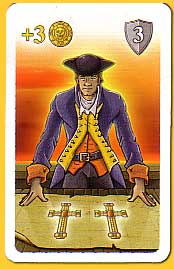
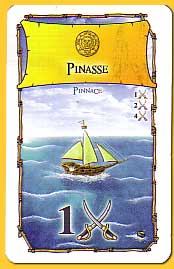
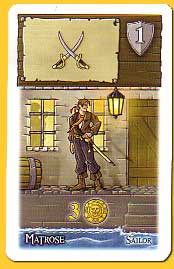
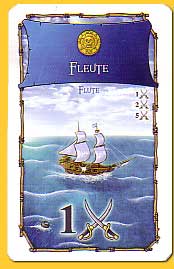
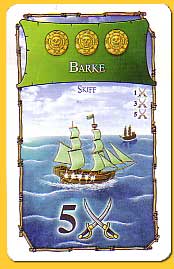
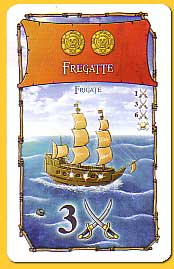
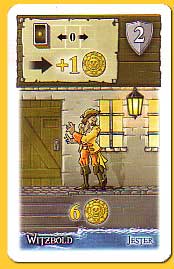
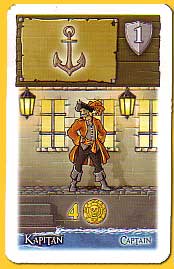
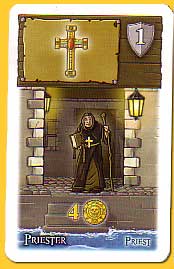
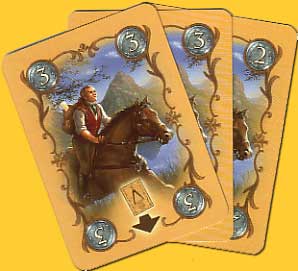
11.04.14 In this card game the players sail the Caribic as merchants, hoping to be able to make a decent living of it. The active player determines how far he wants to travel: he draws as many cards as he wants and places them face-up. When he decides to stop, the journey is over. The active player first picks a card from the face-up row. Ship cards yield money; this is called ‘robbery’ in the rule book, which is not quite what we expect from merchants, but anyway… Character cards, on the contrary, cost money. After the active player has selected his card, all other players are also allowed to choose one, BUT they have to pay the active player 1 coin for this privilege. Purchased character cards are placed face-up in front of the players; from now on, they are allowed to use the character’s abilities and symbols. The character cards are also worth victory points. |
|||||||||||||||||||||||||||||||||||||||||
| x | |||||||||||||||||||||||||||||||||||||||||
| x | |||||||||||||||||||||||||||||||||||||||||
| x | |||||||||||||||||||||||||||||||||||||||||
| x | |||||||||||||||||||||||||||||||||||||||||
|
Gear & Piston | ||||||||||||||||||||||||||||||||||||||||
| 09.11.13 Everyone who has an idea for a game, can take it to a publisher. That's how it was in the old days, and that's how it works nowadays, with the difference being that now there's more choice in how and where to publish the game. When the large publishers are not interested, then maybe a smaller one is. And otherwise one can set up something by oneself for the occasion that can be called 'publisher', where in fact business is operated from the living room as a distribution channel is lacking. But the heart of the matter is that the game is published! In many cases, it would have been better if the game hadn't been published at all. That's why large publishers make use of editors who take a closer look at the games that are presented to them. But one day a variant of The Game Of Life arrives, and another day a variant on Mensch ärgere Dich Nicht/Parcheesi; for an editor it must feel like searching for the Holy Grail. It most certainly won't be a very uplifting task to over and over again try to keep retained and controlled in the standaard rejection and give it just that personal touch whereby the inventor's feelings are not badly hurt. Many games inventors live an all too isolated life, haven't understood anything about marketing and think their game is the innovative breakthrough for which games land, and the consumer, is waiting. When the money is lacking to fulfill that dream, another possibility shows up nowadays: that of crowd funding. But again no real effort has to be made as everything is institutionalised by stages like Kickstarter. When enough people are willing to support the project, there also is no investment risk; it is like driving in a tuned up wheel chair in a residential area where all speed bumps have been removed; there simply is no risk of hurting oneself, so what could possibly happen? Continuity is not something a selfmade ‘publisher’ thinks of when publishing his first game since it all started about the realization of a lifelong dream. When the initial response and sales results are not directly discouraging and ‘playing shop’ actually is experienced as quite fun, there is that tiny but yet frustrating problem: there is no next game; after all the firstling took three, four years and more of development and there were no thoughts of how to act in the period thereafter. Consequently these ‘publishers’ present themselves as nestors and initiators of the firstfruits of other inventors who could not find a publishing house and maybe even feel themselves comfortable by the cosy environment of the domestic operating nestor. This results in even more games noone really is waiting for, and, unfortunately because of the large annual influx of new games, not all can be reviewed and where necessary warned for, so the interested buyer is left in the lurch: he may think he has something nice in his hands, but actually returns home with a pig in a poke. 'Gear & Piston' has all the characteristics of a redundant game: rig up cars doesn’t sound all too exciting in the first place, but when this has to be done by in playing order collecting and placing tiles, then Domino suddenly sounds as a terrific fun game. Oh yes, there are investors with specific end game bonuses, a black market, parts from the junkyard, and tiles that have to be placed when the car is not finished at game end; there also is an attached expansion probably considered necessary because the original game gave the inventors - ultimately but too late - the insight that the original game was obviously boring, notwithstanding the fact that the expansion does not change anything to it. The repeatedly and pointless adjusting the volatility list at the beginning of each round (‘handy for at the end of the game!’) very well reflects the atmosphere of Gear & Piston: redundant and a waste of time. Gear & Piston, Jukka Höysniemi, LudiCreations, 2013 – 2 to 6 players, 8 years and up, 30-60 minutesxxtop  |
 |
||||||||||||||||||||||||||||||||||||||||
| x | |||||||||||||||||||||||||||||||||||||||||
|
Grill Party | ||||||||||||||||||||||||||||||||||||||||
| 04.10.12 They manage to find the bottle opener, the men, in the kitchen, but usually they stay far away from this location. Their aversion from cooking disappears when a barbecue is organised; then they set up as true fire-eaters, and the master chiefs without any exception can be found near the grill. That this cooking merely comes down to playing with fire, is forgiven by their spouses, and too, that the majority of the meat leaves the grill in a blackened state. That having a barbecue is a typical testosteron thingy is also supported by the box illustration of ‘Grill Party’: a man is standing astride, the grill at crotch height as his target at zero hundred hours, the hunting weapon in his hand; we’ll just see who’ll be the winner of the battle to come! The cardboard grill is placed in the center of the table, on it the four different kind of food: corn, fish, sausage and steak. Each player receives a plate and also four of these food; he chooses one to be placed on his plate. From a private stack of twenty cards, one is turned face up and placed near the grill; four cards are drawn and form a players hand, the rest of the deck is the draw pile. In a turn, a player does the following: he empties his plate, chooses one food from the grill that he places on his plate and chooses one of the four food that are next to his plate to be placed on the grill. He now may play one to four cards, provided he meets its conditions. These cards come in three varieties for each of the food: more X than Y, the most X, no X. If for instance there is one corn on the grill but no sausage, the card ‘Mehr Mais als Wurst’ (more corn than sausage) can be played. In case there was one sausage on the grill, at least two corn had to be on it also in order to be able to play this card. When a player cannot play any (more) cards, his turn is over, eventually refilling his hand to four. The last played card of a player is an obstacle for other players, as they are not allowed to play this card in their turn that is placed on a stack near the grill. In short: no same card may be played twice within a round. When there’s no one food of a players liking on the grill, he may change it with an other player, but anything that is on another player’s plate is no-go area. Winner is the player who is the first to play all his twenty cards. The game plays best with two or three players, maybe even with four; but with five players luck prevails. ‘Grill Party’, we’d gladly like to be invited: it’s easily digestible, served quickly, and has a great atmosphere! Grill Party, Jordi Genë & Gregorio Morales, Kosmos, 2012 - 2 to 5 players, 10 years and up, 30 minutesxxtop |
 |
||||||||||||||||||||||||||||||||||||||||
| x | |||||||||||||||||||||||||||||||||||||||||
|
Get Bit! | ||||||||||||||||||||||||||||||||||||||||
| 12.10.11 This is the case: each player has an amphibious robot that unsuspectingly enters the sea for a refreshing swim. What they should know is that a shark infests the waters. At the beginning of the game, the robots are randomly placed in a line, the shark is put at the end. A round consists of simultaneous playing a number card, robots of players who have played the same number do not move. The other players move their robots starting with the player who played the lowest number , and places his robot in front - that robot should be safe for the shark, you might think - and so on to the highest played card! But when all other players also move forward, the starting player is back in line again and his robot loses a limb! So you want to play a high card, but when another player plays the same number, your robot stays put and you will anxiously have to wait and see if you do not land in front of the jaws of the shark. The rules are certainly clear about one thing: you do not have to swim faster than the shark, if only you are faster than your fellow players! When a robot is bitten and a random limb has been removed, it advances to the front of the line and consequently starts the next round in front; each player again chooses a numbered card from his hand and his robot moves accordingly. Only when a player's hand is empty, he takes all played cards back in his hand. An exception is made for the 'bitten' player, who immediately takes all played cards in his hand. All this could be played quite tactical, but at least it's very hilarious, and the game does not take long. The shark with moving jaws also gives the game that extra feel. 'Get Bit!' is a very nice addition to the beer and pretzels segment: uncomplicated laughter in as little time as possible! And we like that! Get Bit!, Dave Chalker, Mayday Games, 2011 - 2 tot 6 spelers vanaf 8 jaar, 10-20 minutenxxtop |
 |
||||||||||||||||||||||||||||||||||||||||
| x | |||||||||||||||||||||||||||||||||||||||||
|
High Five! | ||||||||||||||||||||||||||||||||||||||||
| 10.12.10 We can play cards, or for the die hard card player who wants to play the occasional game but wants to stay close to his favorite pastime, we can pretend that we play cards. 'Rummicub' proved to be the golden discovery and since then many poker variants have seen the light among which the very succesful 'Yahzee'. But now there is 'High Five!'! Now everything will be different! Or won't it? The game consists of a card set with numbers ranging from 1 to 14, where the 1 also counts as 14 (where does this remind us of?) in four different colours (wow, instead of card symbols - ingenious!). A player starts with four blindly drawn cards and a joker, and in his turn he places one to four cards and redraws two. Several poker related combinations of five numbers score various points; the socalled 'high five' consisting of four numbers and a joker scores the most. The game lasts until all cards have been placed on the board. Because of the small gid of 8 by 8 and because of the limited supply of cards a player has, tactical placement nearly is impossible but to be frank in fact the whole game doesn't attract us at all. What a terrible uninspiring sadness! It feels as if we are catapulted back into the eigthies! This tasteless cocktail varies on this, that and the other but has far exceeded its expiration date. It does not captivate or challenge just a little. Besides the author there has to be a game editor too who hasn't noticed that the poker suitcases were on close out already a few years ago... High Five!, Nils van Teijlingen, Kosmos, 2010 - 2 to 4 players, 8 years and up, 30 minutesxxtop |
 |
||||||||||||||||||||||||||||||||||||||||
| x | |||||||||||||||||||||||||||||||||||||||||
 |
Hotel Samoa | ||||||||||||||||||||||||||||||||||||||||
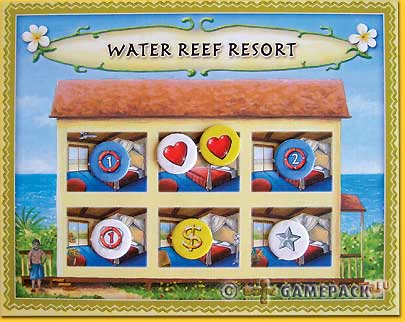
| 18.07.10 In 'Hotel Samoa' we take a look behind the screens of the hotel branche on a not specified holiday island, where players try to manage the tourist streams that arrive at the island and that hopefully will take a room in our hotel. To achieve this our prices must be competive, of course. At the beginning of the game the whole tourist season already is clear, visualised by large cardboard cards with suitcases and a national flag on them; of each of the four nationalities three cards are present; the twelve cards are placed in a random order and are worked one by one. Dependent on the amount of players corresponding tourist chits are drawn from a blind pile and divided in two or three groups. Next, players simultaneously play a card from their hand; it states the price of the rooms in their hotel for this round. The player with the lowest price gets the first pick of tourists; he earns as much as the amount of tourists multiplied with the room price, with the player with the most money at game end has won. When the tourists have arrived at the hotel they earn no further income so the management would love to see them leave as oon as possible - they are a bit of a nuisance, as in Fawlty Towers, as they occupy rooms that according to modern bookkeeping temporarily earn no income. Each time when at the start of a round a plane has landed with a group of a nationality already on the island, the latter leave their hotels to head for home, making room for the new group that again choose to book the hotel with the lowest price, then the next lowest, and so on, till there a no more tourists or when each player had a chance to take any tourist to his hotel. The mechanism that tourists only leave when new tourists of the same nationality arrive makes nationalities popular that only stay for a round or two as they earn quick money. Additional income comes from tourists that book a room next to a celebrity, and rich tourists who pay double the price with ease. Running short of rooms can be partially neutralised when you house two tourists who fall in love quite easily: they share a room but pay for two. At the same time with the played room price card a player bids on one of the expansions such as an extra room, a swimming pool, or a suite that all generate extra income. But the investment does not necessarily pays back, for instance when the swimming pool has been constructed but not sufficient swimmers find their way to the hotel. 'Hotel Samoa' is a nice game for a game or two, three, but it will not captivate for much longer than that; it is too much of the same each round. The blind bidding does not offer enough tension, and in this manner the game ripples on. It is like being free from work, but staying home for holiday: no obligation to go to work, but nothing sensational to encounter either. In this respect one could say that 'Hotel Samoa' is the bread you butter at home -but players generally want a more exclusive meal. Hotel Samoa, Kristian R.A. Østby, Huch & Friends / White Goblin Games, 2010 - 3 to 6 players, 10 years and up, 45-60 minutesxxtop |
|
||||||||||||||||||||||||||||||||||||||||
| x | |||||||||||||||||||||||||||||||||||||||||
|
Glen More | ||||||||||||||||||||||||||||||||||||||||
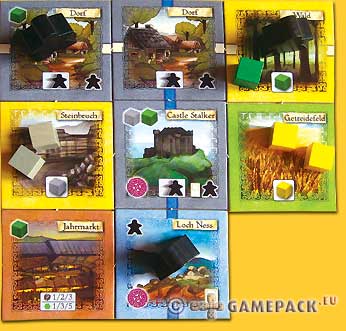
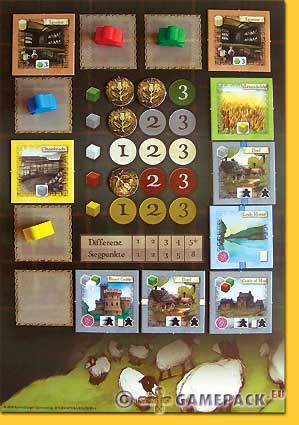
| 06.06.10 The player in this game who acquires the best tiles, activates these and exchanges the product for points has won; it is the common three step mechanic. Scotland or any other random location anno Pick Your Date; the setting doesn't matter of course. Each player individually starts from his initial village and tries to match various tiles in such a way that they can be activated and produce something. Placement is only allowed if there is a clan member around and the only other restriction comes from tiles with rivers and roads that have to be connected. The placed tile and any other adjacent tiles are activated: woods produce a green cube, quarries a grey, fields a brown and grassland a white cube. The cubes are placed on the tiles and three is the maximum so we must find a way to make them profitable. This can be done by tiles that have production buildings on them such as the slaughter house, the destillery or common fairs. When these are activated the cubes can be exchanged for points. New tiles can be acquired through a display on which the player tokens are moved. The player last in line may move first and may advance as far as he wishes to take the tile of his choice and fit it in his collection but he only gets another turn if the other players have overtaken him and he is last again. This way a player can have multiple consecutive turns. We saw this nice mechanism before in 'Neuland' from Eggertspiele and more recently in games as 'Tinner's Trail' and 'Opera'. When a stack of tiles is depleted there is a score but there is not much to get; scoring depends on the difference in whiskey and clan members with other players and ofcourse all try to score. After three stacks and the same scores the game ends. Villages are important as they provide a new clan member and this broadens the tile placement options. There seems to be a starting player advantage as this player can take the first and often only village in the display. A fourth and fifth player surely has no choice and must wait for a better opportunity and this feels unbalanced. When a player has placed his tile players at some distance have little chance of monitoring in what the player hands are fiddling with on that tiny surface. And which tile was placed again? It is a real fiddling game, niggling on a tiny surface, with mechanical rules (that are set in midget size and are an offence to the reader): when a player moves a clan member off a tile and puts it aside, it might qualify for scoring. Now that makes sense! Real Scottish! 'Glen More' lacks a heart, it lacks emotion. It goes like scoring a point here and scoring a point there, but it lacks the great gesture. The game might be suitable as course materials for autists, but to us, it just made us depressive... Glen More, Matthias Cramer, Alea/Ravensburger - Heidelberger Spieleverlag, 2010 - 2 to 5 players, 10 years and up, 45-70 minutesxxtop |
|
||||||||||||||||||||||||||||||||||||||||
| x | |||||||||||||||||||||||||||||||||||||||||
|
Hotel Amsterdam | 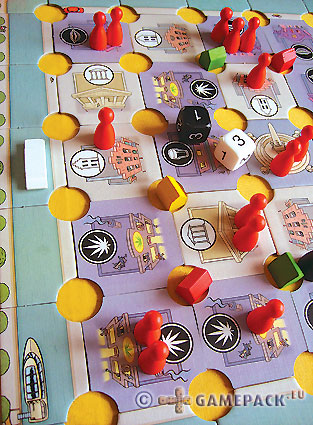 |
|||||||||||||||||||||||||||||||||||||||
| 16.02.10 Every large city has its own tourist flow, often preceded by an Alknowing Leader with Distinctive Sign. Umbrellas seem to be perfectly fit for this job, but in 'Hotel Amsterdam' only the individual traveller gets a chance, and these seek the attractions of the city without any guidance. At first, this goes quite randomly: the throw of two dice determine where they will land and consequently which location they will visit. This varies from the day programs visiting a museum and souvenir shop to the more obscure pastimes like visiting the ladies of pleasure and going to buy some weed; yes, this is Amsterdam people, I don't know if you citizens are proud of it! At the start of the first two player turns a player places his hotel between one of the lots; his goal is to collect twelve tourists around his two hotels in order to win the game. Tourists can be moved when the black or white pawn changes the colour of the location from day to night time or or vice versa. Tourists find a new home at the next nearby location of the same signature that is free. And each player turn the roundtrip boat drops a new tourist; fine if one has a hotel next to the location, but a source of sorrow for every other player: how do I get these tourists away from that location, and move them to my own hotel? 'Hotel Amsterdam' is a wolf in sheep's clothing; it looks like a simple and cheerful game. Cheerful it sure is, but simple, well, that depends. of course the game can be played as deep as the players sitting around the table and as such it is very well suited to play with and for children if the night locations are named somewhat different... But the seasoned player certainly also has a very nice challenge here. The game has a nice invented theme and plays nice and swift. For those who want to eliminate the last element of luck: there is a variant without dice. The only criticism could be that the tourists are represented by basic tokens; these cold have been nicer figures. But on the other hand, the livery of tourists, one has no say on that; they just dine in a restaurant with short trousers and sandals! Hotel Amsterdam, Hans van Tol, The Game Master, 2009 - 2 to 4 players, 8 years and up, 30-45 minutesxxtopxxx |
|||||||||||||||||||||||||||||||||||||||||
| x | |||||||||||||||||||||||||||||||||||||||||
|
Horus | ||||||||||||||||||||||||||||||||||||||||
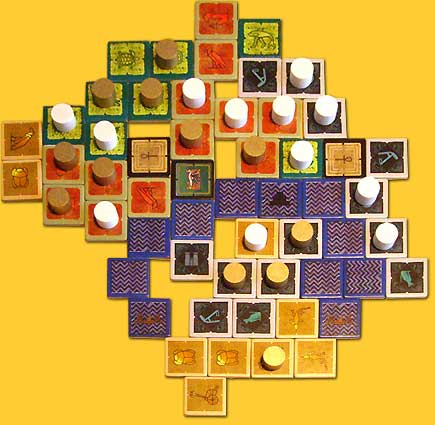
| 27.05.08 Each culture has its slow flowing rivers somewhere in the landscape, and the old Egyptians are no exception to this as they have the Nile. This river with its fertile banks is the setting of Horus. Players each try to claim the profitable fields to score the points for them, yes, we already are talking game talk here, because what we are going to do is placing different kinds of tiles in order to try to get a majority in these fields. This is how it goes: first a tile is drawn from a cloth bag and placed according to the rules. After that a card is played from the active players hand; this shows the kind of tile he has to place as the second tile, taking it from one of the sorted stacks next to the ‘board’. The card also shows a number from one to five that is the condition for putting a claim stone (‘kingdom stone’) on one of the empty field tiles. As the last action in his turn, a player draws a new card and puts it in his hands; after that it is the next players turn. The game ends when two of the five piles of field tiles are depleted, after which all fields are checked to see which player has the most influence in a field. No field can score more than ten points, even if it is more than ten tiles large. Another restriction during the game is that a player cannot add a claim stone when the area has grown larger than five field tiles. The game starts with three river tiles, and players place their tile adjacent to the river or other already placed tiles. The river can be expanded and twined to try to enclose fields, as these double the score at game end. The player who has the most claim stones in an area scores the amount of tiles of that area in points; if tied the score is halved. This does not sound all too interesting, and in fact it is not; it is just a dull game in which the mechanism predominates. The lack of atmosphere and the uninspired illustrations of the tiles also contribute to this. It all feels like looking at a badly organised Excel sheet: are we supposed to digest this? No thanks, we will pass the plate; Horus is just not to our liking. Horus, H. Jean Vanaise, Amigo Spiele, 2008 - 2 to 4 players, 10 years and up, 60 minutesxxtop |
 |
||||||||||||||||||||||||||||||||||||||||
| x | |||||||||||||||||||||||||||||||||||||||||
|
Gisborne | ||||||||||||||||||||||||||||||||||||||||
| 03.03.08 We do not know how modern man handles manuals after he has bought and unwrapped his latest purchase, but Clementoni has little confidence in it and added a last sentence in the rules to keep and store it. Here we find the spirit of the computer era: immediately hands on operative with no need to read the manual, we can do without it we think because how hard can it be, but it does not take that long before a nephew or neighbour has to come to the rescue. When we really have made a mess of it, we make up an excuse to buy a new computer, because the current quirky one does not suffice anymore. That we have loaded 700 fonts and have twelve programs open, while at the same time downloading a movie, we sensibly forget. Think and act like it seems to be not fashionable anymore, no, hands on is the latest thing and gets us any further! The adventurers who really had to find it out for themselves are of a past era, such as the mapping of New Zealand, after it was discovvered by Dutchman Abel Tasman who, by order of the Dutch East Indian company VOC actually was in search of the mysterious and in the course of the ages enygmatic and supposedly rich Teraa Australia Incognita. Whether Gisborne was responsible for mapping the inland of New Zealand is not sure - wikipedia only mentions him as a colonial secretary - but it sure sounds exotic! Because our daily life has enough mishaps as described above already, the encountered adventures in 'Gisborne' are easily to overcome: we play some cards, walk over narrow tracks, and collect map chits along the way that represent the mapping of the inland. Unexpected obstacles such as swamps or packs of wolves hinder the players in their progress. The map board sections are added one by one: when a player would walk off from one board section, a new one is added immediately, this way keeping the moving adventurer on track. So far nothing new, if it were not for the cards that are used for moving. These come in three categories: gold, silver and bronze, and in a turn players simultaneously and secretly decide how much cards of a single category they will use for movement of their token. The player whose token is in front starts, with all other players following in order; the sum fo the played cards must be used fully. If a space is occupied, the token is moved onto the next empty field. If a player has taken any card chit in a round, all players take cards: the player in front may take three, and decides if he wants to take these in his hand for movement, or put any or all of them in his chest - each card being worth one point at game end. The second placed player takes two cards and decides likewise. A third player (in a 4 or 5 player game) gets one card, and the last player always gets two cards with no choice but to take these into his hands. There is a second possibility to obtain ccards: by playing the tent card - the player does not move but may take two cards, and his tent card back into his hand. When the island has been crossed and the coast of the last section has been reached, the game ends and all players count their points in their chests. 'Gisborne' has everything many other games also have, and this at the same time is its downside: the game functions but does not captivate; it is 'nice' but has nothing intriguing. Because of this, 'Gisborne' places itself in the broad class of mediocre games. Being a part of this collection, it does not matter anymore that it has a pasted on theme, or that the rucksacked tokens, if placed wrongly, bear a strong resemblance to Dolly Parton, or even that after each play the card board chests must be taken apart again in order to fit into the box... Gisborne, Carlo A. Rossi, Clementoni, 2008 - 2 to 5 players, 8 years and up, 30 to 40 minutesxxtop  |
|
||||||||||||||||||||||||||||||||||||||||
| x | |||||||||||||||||||||||||||||||||||||||||
|
Gangster | ||||||||||||||||||||||||||||||||||||||||
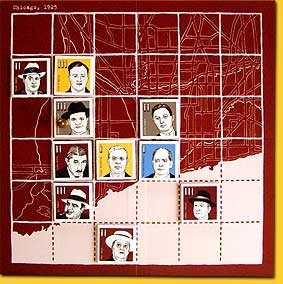
| 10.08.07 Would you please follow me? We are going back in time, to the twenties, in the Chicago of the Prohibition. Rivalling gangster mobs waged a life-and-death struggle with each other, to collect the profitable returns from the liquor just for themselves. Two to four players enter the lists against each other to achieve the most power. We already have visions of a world of glitter, limousines, smoky speak easies, shoot outs, tempting vamps, money, luxurous items and fashionable clothes. We are ready for it! Where are our two tones? Unfortunately, nothing comes from this atmosphere: the map of Chicago on which the action takes place only shows some vague lines on a cheerless brown little map board that is divided in a 6 x 6 grid; each turn we place one of the available mob tiles on it, or move an already placed tile. When a row or column is complete, points are awarded. Only the player with the highest mob points scores: as many points as he has bullets on the tiles, with points substracted from the player with the second best points (but who does not score). Does this sound abstract? It is! To pimp up the atmosphere of the game, real bullet shells are supplied with which an adjacent rival on the board can be shot; after such a single sided 'shoot out' the tile cannot be moved, and does not count anymore in a score. That is all; after twenty to thirty minutes the stock of tiles is depleted or a player has managed to achieve the score that entitles him ‘Al Capone’. Meanwhile we have randomly placed tiles from a stock with two open tiles to choose from. Not very exciting, we did encounter nothing of the gangster atmosphere, there wasn’t any blinding glamour, just the feeling of ‘Six In A Row’... The portraits of the gangsters probably are drawn from photos; it is a style from a design movement that in the seventies was very popular - the so called ‘Swiss typography’ that only allowed the occasional black and white drawing in outline with turning a blind eye to the 'spoiling' use of a second colour - but certainly not representative for the style of the ‘roaring twenties’ some fifty years earlier. The whole design and the style of the illustrations give a rather poor feeling and is in contrast with the era; despite the neatly constructed wooden box that the game comes in. Further, the bullets give the game a sinister tinge; the borderline 'game versus reality' has been crossed clearly here. Other publishers with a comparable theme enclose a foam gun (Ca$h & Gun$, Repos) or even a squirt gun (Gangsters, Avalon Hill), and stay on the safe cartoonesque side. Well, at least we can use the box for storing tea - for a game of this calibre it is just one size too large... Gangster, Czarné, LudoArt, 2006 - 2 to 4 players, 9 years and up, 25 minutesxxtop |
|
||||||||||||||||||||||||||||||||||||||||
| x | |||||||||||||||||||||||||||||||||||||||||
|
Guatemala Café | ||||||||||||||||||||||||||||||||||||||||
|
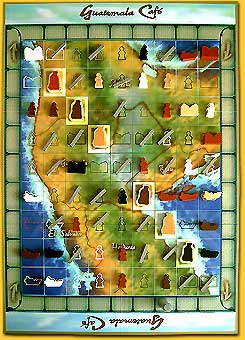
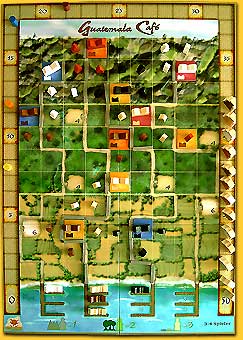
29.03.07 Attention coffee lovers! Or rather: watch out! The enclosed coffee in Guatemala Café is not meant for consumption. So if you bought the game for this purpose, you might be disappointed. But how should you know that tiny undersized but lovely smelling coffee beans are supplied with the game; didn’ t we go out to the shop to buy the game for its kindling instead, did we not? Why? Because Eggertspiele must have closed a very secret and profitable contract with the local forester, when we look at the game components: wooden figurines, wooden sticks, wooden sheds, ships and coffee bags; the game box is brimful of wood, a box of bricks is nothing compared with it. And when it comes to game boards, on its production was not cut on costs either: there are two of them, both printed on two sides for varying participating players and variants. |
|
||||||||||||||||||||||||||||||||||||||||
| x | |||||||||||||||||||||||||||||||||||||||||
|
Garden Competition | ||||||||||||||||||||||||||||||||||||||||
|
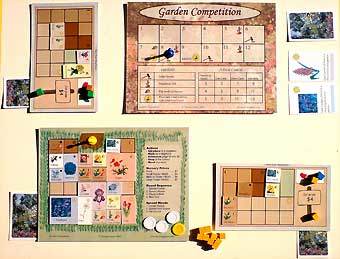
19.02.07 Spring is in the air, time to get the garden out of its winter sleep. You have just moved and want to impress the neighbourhood by winning the annual garden competition. In this game you start out with a blank board representing your garden. The garden is divided into three sections: full sun, half-shade and shade. During the twelve rounds of the game, you try to fill your garden with an abundance of colourful flowers. However at the end of the game the jury will only reward victory points for flowers and colours that are to their taste. During the game the jury will reveal some of their taste. There are two ways to get flowers for your garden. You can buy them from the general nursery. In the first part of the game flowers can be bought as seeds, this is a lot cheaper than when you have to buy them later in the game when they are flourishing. However in the first rounds of the game very little is known about the taste of the judges, which makes it difficult to know which flowers will earn you points at the end of the game. It is also possible to introduce yourself to the neighbours and to perform chores in and around their house, like babysitting and lawn mowing for either money or favours. In rounds five, eight and eleven the neighbours will give flowers to those who have done the most chores for favours. This is the second way to get flowers. However it is not a bed of roses all the time, every garden suffers from weeds at some point. Weeds exponentially grow from your garden to the neighbour’s garden and back again, it is necessary to keep them under control. Weeding a weed costs one action and a player can only perform two actions per turn, a nasty job like weeding is therefore often skipped by players. Except buying flowers, doing chores and weeding, a player can also buy a judge a cup of coffee to schmooze with them and figure out their taste. After twelve rounds points are rewarded for each flower and colour that corresponds to the taste of the jury; for every weed in your garden a point is subtracted from your score. ‘Garden Competition’ is a surprising and friendly game. The theme of the game, gardening, appears clearly. It is a pity however, that the semi-professional producer Toccata Games charges 40 Canadian Dollar for sending on top of the already substantial game price. Marijn Vis |
 |
||||||||||||||||||||||||||||||||||||||||
| x | |||||||||||||||||||||||||||||||||||||||||
|
Hermagor | ||||||||||||||||||||||||||||||||||||||||
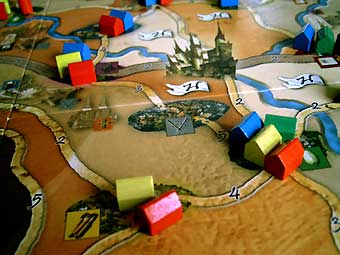
| 29.10.06 Hermagor, it's an intriguing name for a city. An impressive castle with twisted spires is depicted on the box. Dragons fly through the sky. Dragon eggs and skulls are traded at the local market. The two to five players will act similar, although not this explicitly. The map shows a network of roads, with in the center the castle of the town where the journey starts, a journey lasting four or five rounds, dependent on the number of players participating. Unfortunately the roads to be travelled are all toll roads, so each section between the villages has to be paid for. First however, goods must be accquired at the market, a small grid in the corner of the map where each round new blindly drawn goods are put. It is here where the struggle between players starts: I want this good, no I! Who may take the goods in the end, is determined by careful placement of four player cilinders (merchants) on the grid, for which also has to be paid. Expenses are made, but players will have to be careful with their money as having the most money by game's end is the way to claim victory. When the goods are divided the journey may start, and each player takes his actions for that round, mostly by visiting villages and selling the goods that are in demand there. The money players get from selling goods can be read from a second goods grid, where players occasionally have the possibility to increase its prices. After trading in a village, a trading post may be put there, which may take income from future visitors, but more important than this is the surrounding and completion of areas with these posts. This entitles a player to put a disc on the goods grid that gives him instant money, and a varying bonus at games end. Because of these bonuses, a player would not like to miss his presence here! Meanwhile we did not encounter any of the suggesting atmosphere on the box cover, but we did have a good time in finding out the most profitable route for our trading and earning money along the way. The symbols on the map are very obscure; in fact the whole map itself lacks current graphic (game) standards. Despite this and the rather abstract game play it is a nice and swift game - who cares that Hermagor in fact is a sleepy village in the Austrian Alps? Hermagor, Emmanuelle Ornella, Mind The Move / Rio Grande Games, 2006 - 2 to 5 players, 12 years and up, 90 to 120 minutesxxtop |
 |
||||||||||||||||||||||||||||||||||||||||
| x | |||||||||||||||||||||||||||||||||||||||||
| x | |||||||||||||||||||||||||||||||||||||||||
 |
|||||||||||||||||||||||||||||||||||||||||
 |
|||||||||||||||||||||||||||||||||||||||||
 |
|||||||||||||||||||||||||||||||||||||||||
| x | |||||||||||||||||||||||||||||||||||||||||
 |
|||||||||||||||||||||||||||||||||||||||||
 |
|||||||||||||||||||||||||||||||||||||||||